PinealonNootropic
Metabolic1/10
- Metabolic1
- Satiety1
- Body Comp2
- Repair5
- Skin & Hair3
- Gut & Immune3
- Cognition8
- Mood6
- Sleep5
- Longevity7
Start from what you want to change rather than from a compound name. Every goal below opens a full vertical — what the research points to, what we stock for it, and how to run it.
Systemic wellness — the compounds most studied for how you age, recover overnight and feel day to day.
Training, recovery and tissue-repair research — for getting back to the gym, the field or the trail sooner.
Start from what you want to change — skin, hair, focus, mood, libido — and see what research points to.
Curated entry points for specific researchers — women, veterinary work, first-timers and bulk buyers.
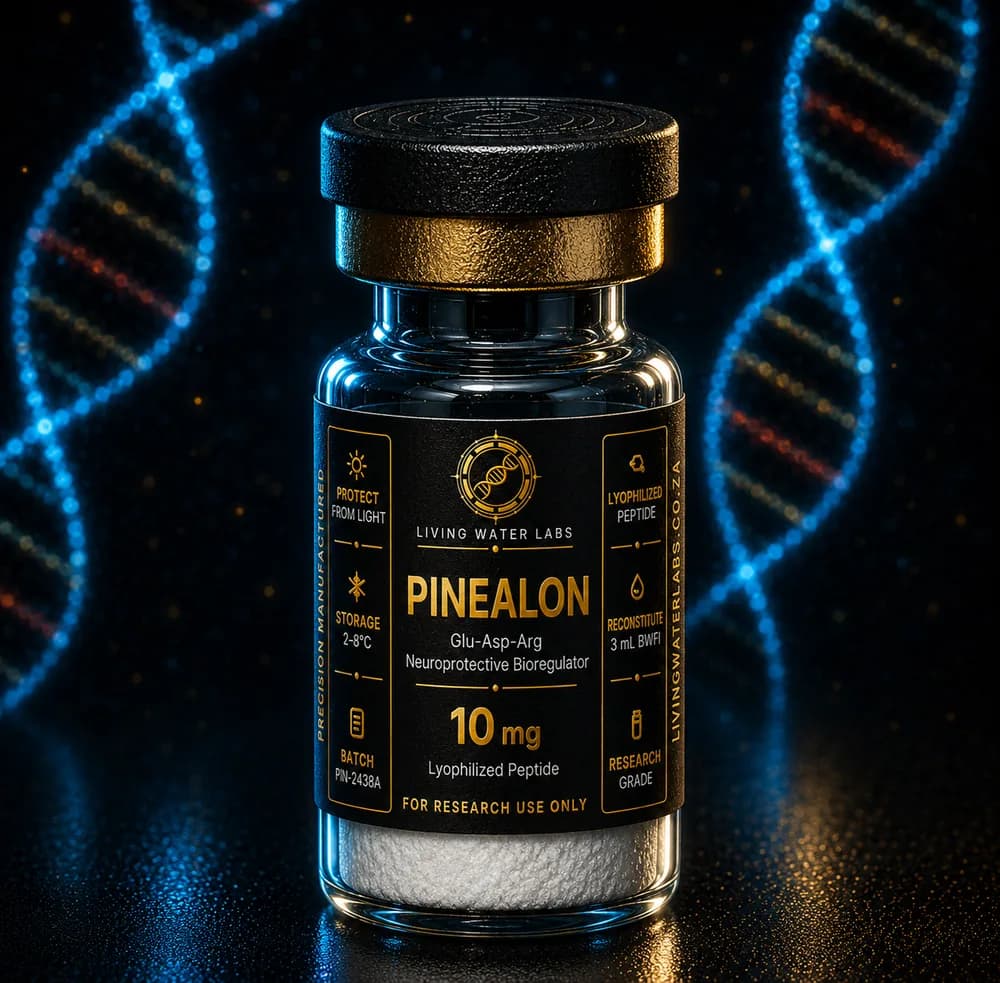
Glu-Asp-Arg (Tripeptide bioregulator)
Synthetic tripeptide bioregulator (Glu-Asp-Arg), 10 mg lyophilised powder per vial.
Earn R19 in points · 5% back as store credit
Quantity
Pre-order now and save 10% — new stock lands 15 Oct
Pre-orders are 10% off. Guaranteed dispatch on Thu 15 Oct: pay now and your order ships first that day.
Restocking · next batch incoming
Be first when Pinealon lands
We’ll email you once — the moment it’s back. No marketing, no sharing.
3 researchers waiting
Delivery estimate
See your dispatch day and arrival dates before you order.
Same R130 courier anywhere in SA · free over R2,500 · PUDO lockers R130.
Quality passport
Certificate available on request
Research profile
Published research on metabolic
Pinealon. Little published research addresses this area for this compound.
PinealonNootropic
Scores summarise published research, most of it laboratory and animal work. They describe what has been studied, not results in people. For research use only.
Evidence profile
EarlyA small research base, largely from one research group, in animal and cell models.
Grades describe how much of each kind of research exists, not what a compound does. Conservative by design.
Cited findings
In 32 adults aged 41–83, Pinealon was associated with improved central-nervous-system activity and a slower rate of ageing by biological-age indicators.
Among geroprotective methods compared in 110 people, combining Pinealon with Vesugen had the most pronounced effect on biological-age indicators.
Increased cell viability by suppressing free-radical levels and activating proliferative processes.
Studied for effects on behaviour and neurochemistry in 18-month-old rats under hypoxia and hypothermia.
Analysed for how the EDR peptide may regulate gene expression and protein synthesis in neurodegeneration research.
Key literature
Animal research
A three-residue Khavinson bioregulator (Glu-Asp-Arg) from St Petersburg — studied in human biological-age programmes and in neural-cell protection.
Pinealon is a synthetic tripeptide (Glu-Asp-Arg) belonging to the family of short peptide bioregulators developed at the St. Petersburg Institute of Bioregulation and Gerontology. As a member of the Khavinson peptide class, it is studied for its proposed ability to penetrate the cell nucleus and interact directly with DNA, modulating gene expression in neuronal tissue. Research has focused on its neuroprotective activity under conditions of hypoxia, oxidative stress, and prenatal hyperhomocysteinemia, where preclinical models report reduced neuronal apoptosis, preserved cognitive function, and normalised antioxidant defence. Pinealon is also investigated for its influence on circadian regulation and its capacity to restore behavioural and learning parameters in aged or stressed animal models. As a small, peptide-bond-stable bioregulator, it serves as a research tool for studying epigenetic and neuroprotective mechanisms. Supplied as a 10 mg vial for laboratory research only.
Mechanism, as studied
At three residues, Pinealon is among the smallest bioregulators — small enough to be studied for direct interaction with DNA.
Also known as
| Product | Pinealon |
|---|---|
| Identity | Glu-Asp-Arg (Tripeptide bioregulator) |
| Size | 10mg |
| Form | Lyophilised powder, sealed vial |
| Mol. weight | 418.4 g/mol |
| Batch | PNL-2601C |
| Price per mg | R42.9 / mg |
| Supply | Up to 4 WeeksTypical research schedule |
| Included | 3 ml bacteriostatic water |
| Storage | Store at −20 °C in a dry, sealed environmentReconstitute with bacteriostatic water; use within 30 days at 4 °C · Avoid repeated freeze–thaw cycles |
| Supplied for | Laboratory research onlyNot for human or veterinary use |
What arrives in your box
Packed in South Africa, dispatched on business days, tracked to your door.
Sealed, lyophilised vial, exactly as listed: compound and strength on the label.
The batch number printed on the vial ties it to its certificate.
Certificate of analysis on request, sent on WhatsApp.
One 3 ml bacteriostatic water vial per peptide vial, at no charge.
Padded, discreet outer box. No product names on the outside.
The Courier Guy waybill is emailed the day it leaves us.
For laboratory research use only. Not for human or veterinary use.
Certificate of analysis
Each certificate is an independent Janoshik Analytical report naming the compound and its HPLC purity. Certificates we have not yet published are available on request.
| Batch | PNL-2601C |
|---|---|
| Mol. weight | 418.4 g/mol |
Every purity certificate we publish → We have not published one for Pinealon yet — ask us for it on WhatsApp 076 680 0306 / 072 926 7667.
Quality is documented by independent Janoshik Analytical reports (compound identity and HPLC purity) linked from each product page, with unpublished certificates available on request. Each Certificate of Analysis names the compound and reports its HPLC purity; published certificates are at livingwaterlabs.co.za/verify and any other is sent on request.
Yes. Our certificates are independent Janoshik Analytical reports naming the compound and its HPLC purity. Published certificates are readable at livingwaterlabs.co.za/verify; for a compound not yet listed there, ask us on WhatsApp and we send it before you order.
Peptides should be stored at -20°C in a sealed, dry environment. Once reconstituted, solutions should be stored at 4°C and used within 30 days, or aliquoted and stored at -80°C for longer-term stability. Avoid repeated freeze-thaw cycles.
Orders are packed and dispatched within 1–2 business days and delivered door-to-door by tracked courier anywhere in South Africa. A tracking number is emailed to you when the courier collects. Standard courier is R130.
We accept EFT bank transfer. Banking details are provided at checkout. Please use your order reference number as payment reference so your order can be processed promptly.
It means every product supplied by Living Water Labs is sold as a research chemical for laboratory and scientific investigation only, and is not supplied for human or veterinary use, not for the diagnosis or treatment of any condition, and not as a food, cosmetic or medicine. Living Water Labs is not a pharmacy, makes no medical or therapeutic claims about any product, and does not provide human dosing, treatment protocols, diagnosis or disease recommendations. What we do provide — identity, purity, certificates, literature, molecular data, reconstitution maths, handling and storage — is listed at livingwaterlabs.co.za/faq#research-use. Buyers confirm legitimate research intent at the point of order.
Research support
Tell us what you are researching and we will help you find your way around the catalogue, the certificates and the literature.
Mon–Fri · 9:00–17:00 SAST · catalogue & documentation help, never dosing advice
No reviews yet
Be the first to review Pinealon
We publish every review we receive, exactly as written. Yours will be the first — no account needed.
DEEP DIVES
RESEARCH BY GOAL
FROM THE WELLNESS JOURNAL
7 min read · Peptides, Metabolic
Explore →2 min read · Peptides, Cognitive
Explore →2 min read · Peptides, Stress
Explore →