◂ RESEARCH LIBRARY
Pinealon research peptide

Research Overview

Pinealon

Neuronal Bioregulator Research

CoA on requestPurity CoAResearch use only

In 60 seconds

Pinealon is a synthetic tripeptide (Glu-Asp-Arg, "EDR") among the Khavinson peptide bioregulators.

  • In cell studies, Pinealon increased cell viability by suppressing free-radical levels and activating proliferation.
  • An analysis of possible mechanisms by which the EDR peptide (pinealon) regulates gene expression and protein synthesis relevant to neurodegeneration research.

OVERVIEW

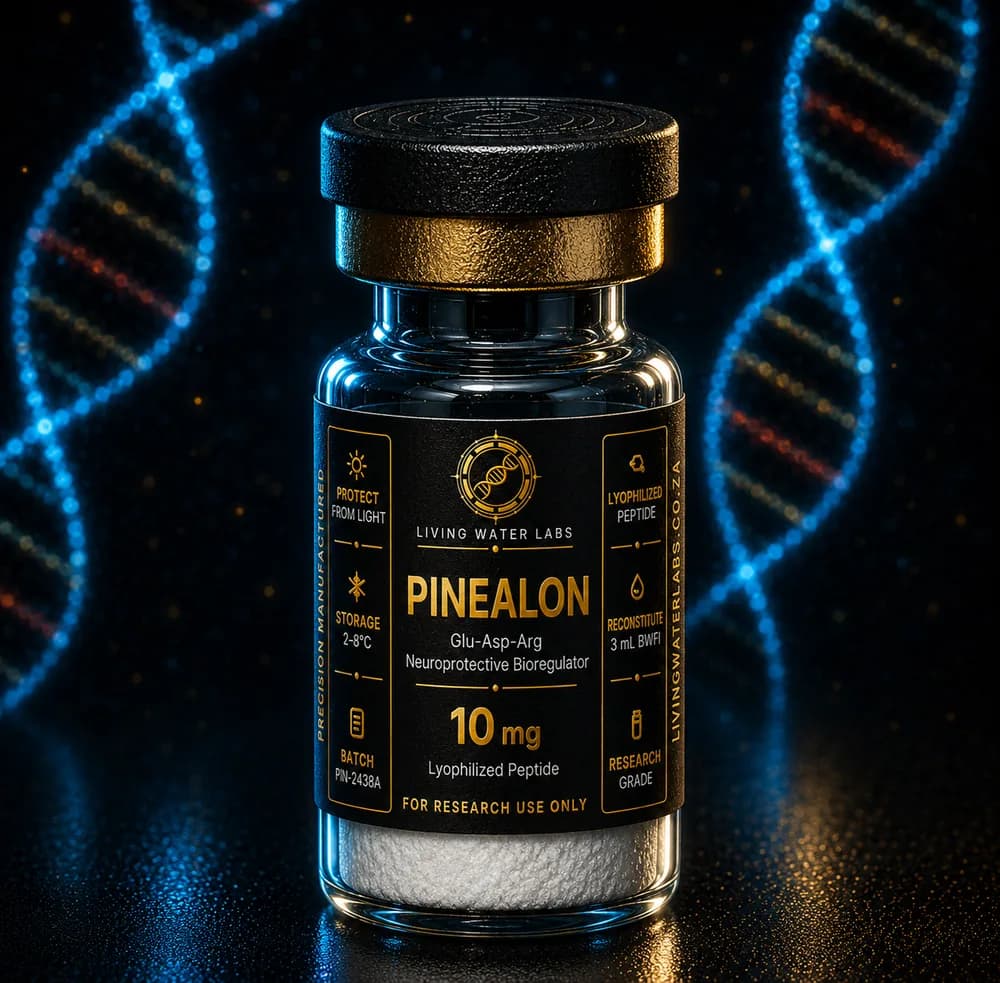
Pinealon (Neuronal Bioregulator Research) is a research-grade peptide supplied by Living Water Labs for laboratory investigation. Synthetic tripeptide bioregulator (Glu-Asp-Arg), 10 mg lyophilised powder per vial.. Each published certificate is an independent Janoshik Analytical report naming the compound and its HPLC purity; certificates not yet published can be requested. The summary below outlines documented mechanisms and study areas reported in the research literature.

Scientific name

Glu-Asp-Arg (Tripeptide bioregulator)

Molecular weight

418.4 g/mol

Vial size

10mg

DOCUMENTED RESEARCH AREAS

  • ▸Proposed nuclear penetration and direct DNA interaction modulating neuronal gene expression
  • ▸Reduces neuronal apoptosis under hypoxic and oxidative-stress conditions
  • ▸Preserves learning and memory parameters in stressed and aged animal models
  • ▸Normalises antioxidant enzyme activity in neural tissue research
  • ▸Protects against prenatal hyperhomocysteinemia-induced neuronal damage
  • ▸Influences circadian and behavioural regulation in preclinical studies
  • ▸Stable short-peptide bioregulator for epigenetic neuroprotection research

MECHANISM OF ACTION

Pinealon is a synthetic tripeptide (Glu-Asp-Arg, "EDR") among the Khavinson peptide bioregulators. Cell and animal studies report antioxidant activity and effects on gene expression and protein synthesis in neural tissue, and it is studied as a short-peptide regulator of neuronal function.

  • ▸Reported to lower free-radical levels and support cell viability in vitro
  • ▸Studied as a short-peptide regulator of neuronal gene expression
  • ▸Investigated for effects on protein synthesis in neural models

STUDY SUMMARIES

2 peer-reviewed references

Rejuvenation Res · 2011

Pinealon increases cell viability by suppression of free radical levels and activating proliferative processes

In cell studies, Pinealon increased cell viability by suppressing free-radical levels and activating proliferation.

View on PubMed (PMID 21978084)

Molecules · 2020

EDR Peptide: Possible Mechanism of Gene Expression and Protein Synthesis Regulation Involved in the Pathogenesis of Alzheimer’s Disease

An analysis of possible mechanisms by which the EDR peptide (pinealon) regulates gene expression and protein synthesis relevant to neurodegeneration research.

View on PubMed (PMID 33396470)

CITATIONS

  1. 1.Pinealon increases cell viability by suppression of free radical levels and activating proliferative processes. Rejuvenation Res. 2011. PMID 21978084. pubmed.ncbi.nlm.nih.gov/21978084
  2. 2.EDR Peptide: Possible Mechanism of Gene Expression and Protein Synthesis Regulation Involved in the Pathogenesis of Alzheimer’s Disease. Molecules. 2020. PMID 33396470. pubmed.ncbi.nlm.nih.gov/33396470

Citations describe findings reported in the referenced preclinical, in-vitro or clinical literature. They are provided for research and educational purposes only and are not a therapeutic claim.

Research synergies · compounds that fit together

Epitalon + Pinealon

Both come from the Khavinson short-peptide bioregulator programme. Epitalon is studied for telomerase activity in cell models; Pinealon for cell viability under oxidative stress. Researchers group them because they share an origin and a theory of short peptides acting on gene expression, which is the basis of the Cerebral Bioregulator stack.

Studied separately · complementary mechanismsPMID 12937682PMID 21978084PMID 14666197See the stack →

Related compounds: Short peptide bioregulators in the compound encyclopedia.

All information is provided for research and educational purposes only and describes findings in preclinical/in-vitro literature. Not medical advice. Products are supplied strictly for research purposes — not for human consumption.

Related Research & Reading

Keep exploring — goal collections, plain-language guides and the wellness journal, all in one place.

Research Axes · 22 Goals

Shop by Goal

Start from what you want to change rather than from a compound name. Every goal below opens a full vertical — what the research points to, what we stock for it, and how to run it.

Browse all goals →

Health & Longevity

Systemic wellness — the compounds most studied for how you age, recover overnight and feel day to day.

Performance & Repair

Training, recovery and tissue-repair research — for getting back to the gym, the field or the trail sooner.

By Concern

Start from what you want to change — skin, hair, focus, mood, libido — and see what research points to.

Who It’s For

Curated entry points for specific researchers — women, veterinary work, first-timers and bulk buyers.

HPLC tested · Janoshik · Janoshik Certificates · Nationwide Delivery