SKIN, GLASS SKIN & K-BEAUTY · DEEP DIVE
Peptides in Skincare: GHK-Cu, SNAP-8 and Argireline Explained
Three of the most talked-about peptides in cosmetic science work in completely different ways. One rebuilds, two relax. Here is the science behind each.
In 60 seconds
GHK-Cu is a remodelling signal: studied for collagen and glycosaminoglycan turnover and skin repair. Argireline and SNAP-8 are expression-line peptides: designed to interfere with the nerve-to-muscle signal behind frown lines. Different targets, which is why formulators combine them.
- GHK-Cu: studied for collagen remodelling and repair.
- Argireline and SNAP-8: designed to soften expression lines via the SNARE complex.
- Different targets, so formulators often pair the classes.
What it is
GHK-Cu, a natural copper-binding tripeptide; Argireline (6 amino acids) and SNAP-8 (8 amino acids), synthetic SNAP-25 mimics.
What researchers looked at
Collagen and repair-gene activity for GHK-Cu; wrinkle measurements in cosmetic and microneedle-patch studies for the SNARE peptides.
What’s still unknown
How much of each penetrates intact skin, and SNAP-8’s effect on its own, since human studies test it inside multi-ingredient formulas.
GHK-Cu: the remodelling signal
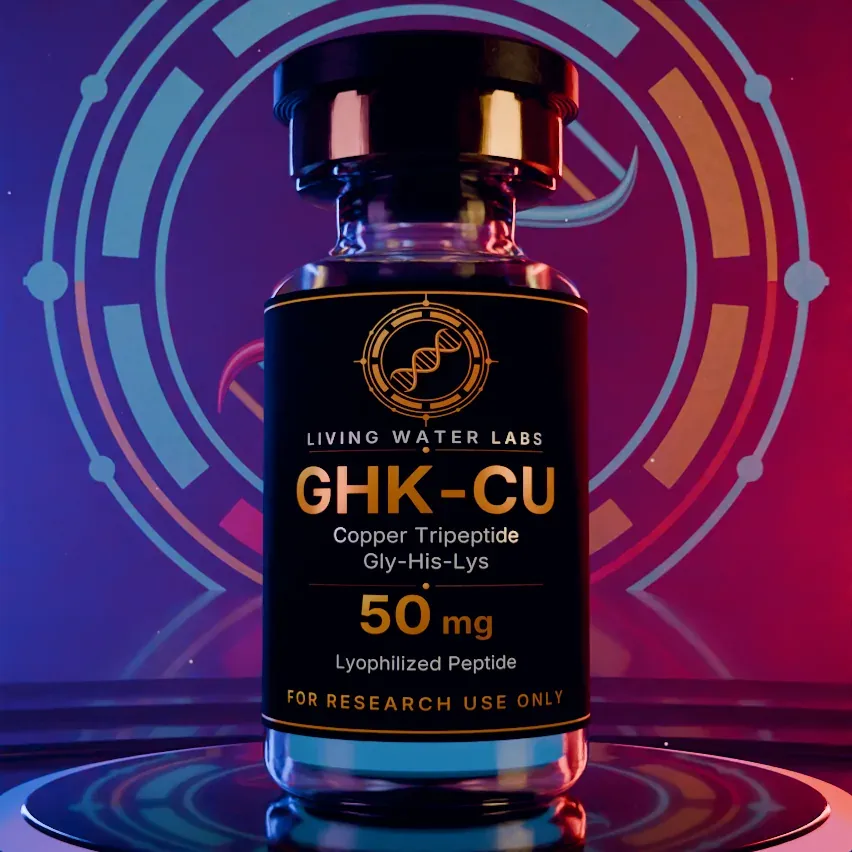
GHK (glycyl-histidyl-lysine) binds copper and is reported to stimulate both the synthesis and the breakdown of collagen and glycosaminoglycans, and to modulate the enzymes that remodel skin. A 2015 review describes it as a modulator of multiple cellular pathways in skin regeneration.
Argireline and SNAP-8: the expression-line peptides
Argireline was rationally designed to mimic part of SNAP-25 and interfere with the SNARE complex, the protein machinery that releases neurotransmitter at the nerve–muscle junction. Its 2002 paper reported anti-wrinkle activity in an emulsion, far milder than botulinum toxin, which was the point of the design.
SNAP-8 (acetyl octapeptide-3) extends the same idea by two amino acids. Clinical studies that include it test multi-ingredient products, such as hyaluronic-acid microneedle patches studied in Korea, so its individual contribution is not isolated.
Why formulators combine them
Visible ageing has more than one cause: matrix loss (collagen, elastin, glycosaminoglycans) and repeated muscle movement. GHK-Cu targets the first and the SNARE peptides the second. They have been studied separately; no published study has tested them as a pair.
KEY TAKEAWAYS
- GHK-Cu: studied for collagen remodelling and repair.
- Argireline and SNAP-8: designed to soften expression lines via the SNARE complex.
- Different targets, so formulators often pair the classes.
Sources · PubMed
- GHK Peptide as a Natural Modulator of Multiple Cellular Pathways in Skin Regeneration · Biomed Res Int 2015 · PMID 26236730
- A synthetic hexapeptide (Argireline) with antiwrinkle activity · Int J Cosmet Sci 2002 · PMID 18498523
- Efficacy of bioactive peptides loaded on hyaluronic acid microneedle patches: A monocentric clinical study · J Cosmet Dermatol 2020 · PMID 31134751
- Clinical Safety and Efficacy Evaluation of a Dissolving Microneedle Patch Having Dual Anti-Wrinkle Effects With Safe and Long-Term Activities · Ann Dermatol 2024 · PMID 39082657