Ipamorelin Research Brief: Selective Ghrelin-Receptor Agonism in Animal Studies
Ipamorelin is a pentapeptide ghrelin-receptor agonist characterised for selective growth-hormone release. This brief summarises the animal pharmacology and bone-formation studies and what they do not show about people.
LWL Research Brief
Evidence · Preliminary01Animal pharmacology and preclinical disease-model studies.
- 02Population
- Rats and swine (characterisation); glucocorticoid-treated rats; animal chemotherapy models.
- 03Intervention
- Ipamorelin, a selective ghrelin-receptor (GHS-R1a) agonist pentapeptide.
- 04Primary endpoint
- Growth-hormone release and selectivity; bone formation; body weight under cisplatin.
05Results
- The characterisation study described ipamorelin as releasing GH with selectivity comparable to GHRH in animals (Eur J Endocrinol 1998).
- In glucocorticoid-treated rats, ipamorelin counteracted the steroid-induced decrease in bone formation (Growth Horm IGF Res 2001).
06Limitations
- Evidence is predominantly animal; human pharmacology data are limited and short-term.
- GH release is a hormonal marker, not a body-composition outcome.
07What this evidence does NOT demonstrate
- Muscle, fat-loss, sleep or recovery outcomes in people.
- Long-term safety of repeated use.
08Citations
- Raun et al. Ipamorelin, the first selective growth hormone secretagogue. Eur J Endocrinol, 1998. PMID 9849822 ↗
- Ipamorelin counteracts glucocorticoid-induced decrease in bone formation. Growth Horm IGF Res, 2001. PMID 11735244 ↗
- GHS-R1a agonists anamorelin and ipamorelin inhibit cisplatin-induced weight loss. Physiol Behav, 2024. PMID 39043357 ↗
Summary of published literature · For research use only · Not medical advice
Growth hormone is not released steadily. It comes in pulses, largely during deep sleep, and that pulsatile pattern appears to be part of how the signal works rather than an accident of biology.
Ipamorelin is a synthetic pentapeptide classified as a growth hormone secretagogue: a compound studied for prompting the pituitary to release growth hormone it has already made, rather than introducing hormone from outside. The research interest is in whether the body's own release pattern is preserved.
Selectivity is the whole argument
Older secretagogues did more than one thing. Alongside growth hormone release, they were associated with elevations in cortisol and prolactin — signals with their own consequences, which complicated interpreting any result.
Ipamorelin is studied specifically because it is described as more selective: research reports growth hormone release with substantially less effect on those other axes. Whatever you think of the category, that selectivity is why this particular peptide is the one that kept being studied.
Where the research clusters
- Sleep architecture: the natural growth hormone pulse is tied to deep sleep, so the two are studied together.
- Recovery: tissue repair and training adaptation.
- Body composition: lean mass and fat mass endpoints, studied as a ratio rather than as scale weight.
- Connective tissue: the collagen-adjacent effects of growth hormone signalling.
A note on expectations
Secretagogue research is about amplitude within a system that already exists. A compound that asks the pituitary to release what it has cannot produce the same magnitude of effect as supplying exogenous hormone, and the research does not claim it does. That constraint is the point of the category, not a shortcoming of it.
What we supply
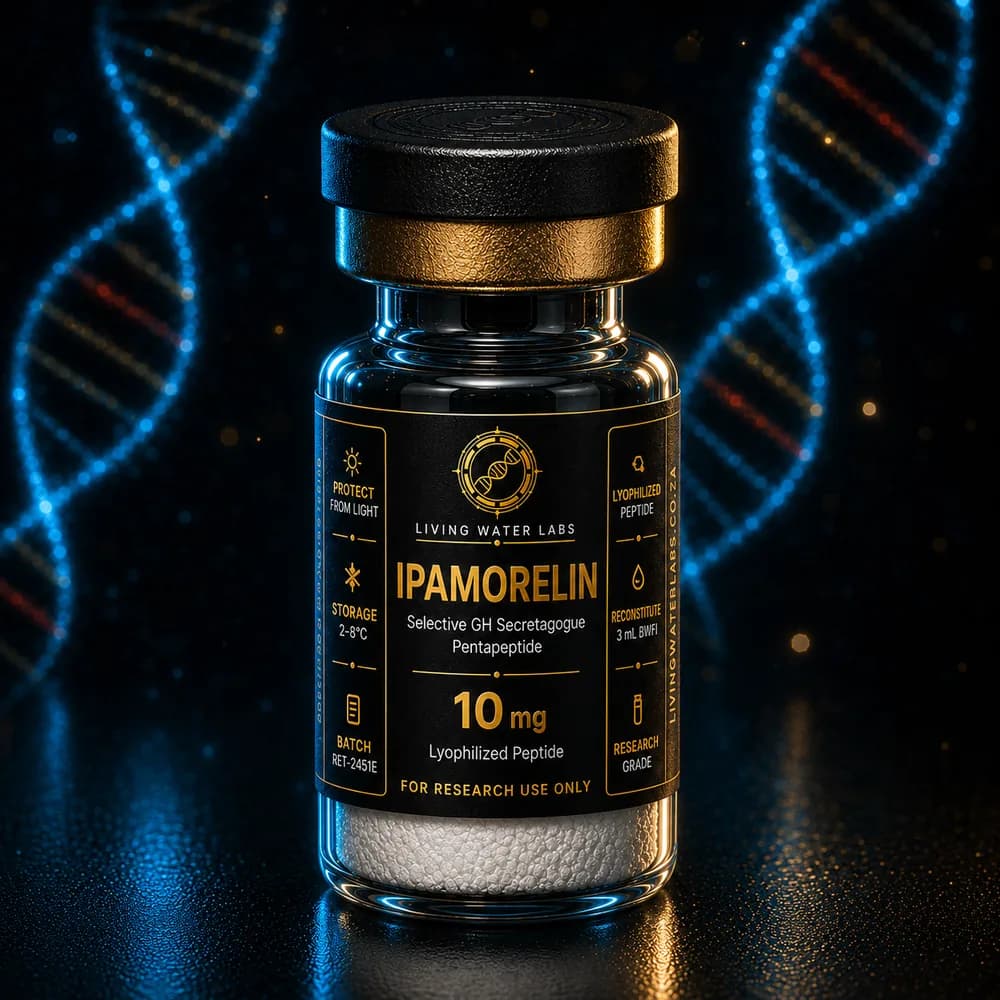
Our Ipamorelin is a 10 mg lyophilised vial, HPLC-verified, with a purity Certificate of Analysis available on request.
Supplied strictly for laboratory research purposes. Not for human or veterinary use.
Reviewed for research accuracy. Educational / research context only — not medical advice.