Drugs Today (Barc) · 2012
The pharmacology of neurotrophic treatment with Cerebrolysin: brain protection and repair
A pharmacology review of Cerebrolysin reported neurotrophic mechanisms of brain protection and repair.
View on PubMed (PMID 22514792)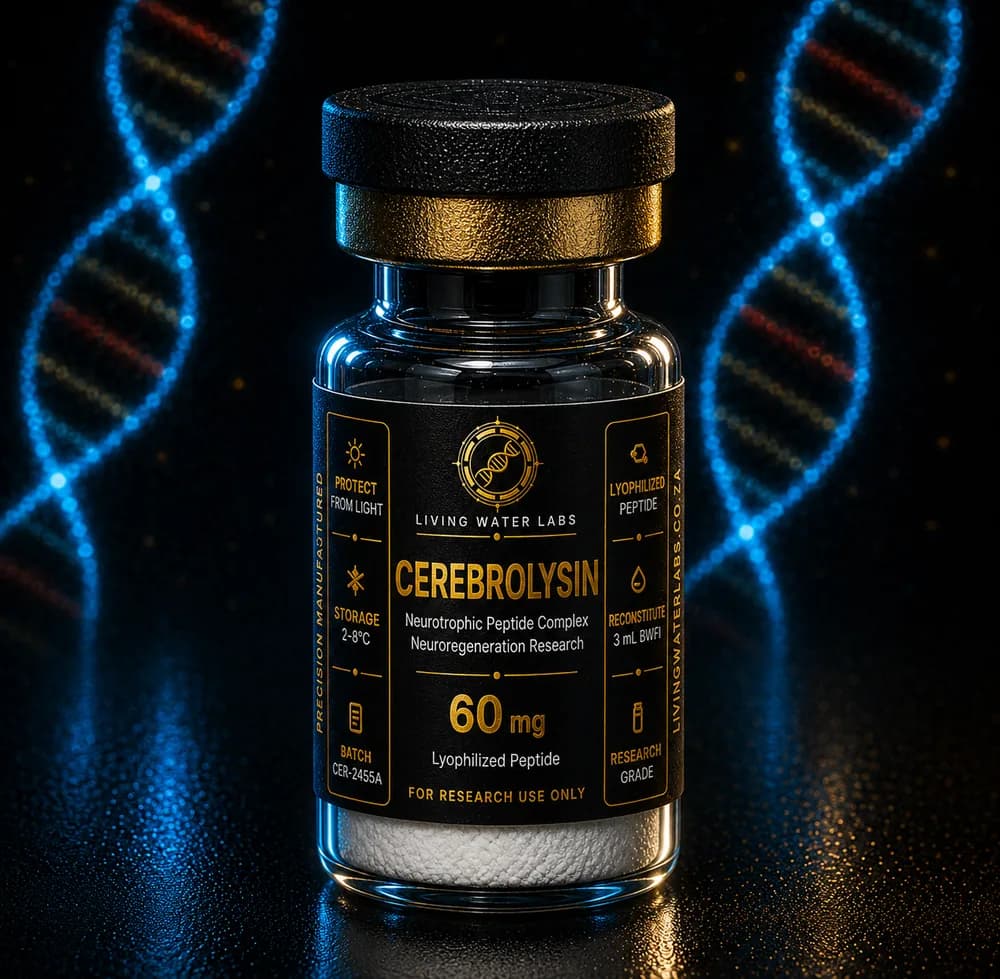
Research Overview
Neurotrophic Peptide Research
Cerebrolysin is a preparation of low-molecular-weight neuropeptides and amino acids derived from porcine brain.
Cerebrolysin (Neurotrophic Peptide Research) is a research-grade peptide supplied by Living Water Labs for laboratory investigation. Standardised neuropeptide preparation, 60 mg lyophilised powder per vial.. Each published certificate is an independent Janoshik Analytical report naming the compound and its HPLC purity; certificates not yet published can be requested. The summary below outlines documented mechanisms and study areas reported in the research literature.
Scientific name
Neuropeptide preparation (Cerebrolysin)
Molecular weight
Peptide mixture (<10,000 Da fraction)
Vial size
60mg
Cerebrolysin is a preparation of low-molecular-weight neuropeptides and amino acids derived from porcine brain. Research describes neurotrophic-like activity — supporting neuronal survival, plasticity and repair signalling — and it has been studied clinically in dementia and stroke.
Drugs Today (Barc) · 2012
A pharmacology review of Cerebrolysin reported neurotrophic mechanisms of brain protection and repair.
View on PubMed (PMID 22514792)Drugs Aging · 2009
A review of the clinical use of Cerebrolysin in dementia.
View on PubMed (PMID 19848437)Cochrane Database Syst Rev · 2019
A Cochrane systematic review assessing the evidence for Cerebrolysin in vascular dementia.
View on PubMed (PMID 31710397)J Neural Transm Suppl · 2002
A trial reporting sustained cognitive and global-function outcomes with Cerebrolysin in moderately severe Alzheimer’s disease.
View on PubMed (PMID 12456069)Citations describe findings reported in the referenced preclinical, in-vitro or clinical literature. They are provided for research and educational purposes only and are not a therapeutic claim.
Related compounds: Nootropic & neuropeptide research compounds in the compound encyclopedia.
All information is provided for research and educational purposes only and describes findings in preclinical/in-vitro literature. Not medical advice. Products are supplied strictly for research purposes — not for human consumption.
Keep exploring — goal collections, plain-language guides and the wellness journal, all in one place.
RESEARCH BY GOAL
GUIDES & TOOLS
Step-by-step guides — reconstitution, dosing, storage, handling and CoAs.
Explore →Work out exact bacteriostatic-water volumes for any vial — a free lab tool.
Explore →Per-compound overviews: documented mechanisms, study areas and cited literature.
Explore →Independent Janoshik Analytical certificates — compound identity and HPLC purity — published as styled summaries, the rest on request.
Explore →Purity, CoAs, storage, shipping and ordering — answered.
Explore →PEPTIDE GLOSSARY
Third-party lab documentation confirming a batch’s identity and purity.
Explore →High-performance liquid chromatography — the assay behind the purity figure on every published certificate.
Explore →Dissolving a lyophilised peptide in bacteriostatic water to a target concentration.
Explore →Freeze-dried to a stable powder for cold, dark, long-term storage.
Explore →Sterile water with 0.9% benzyl alcohol, used to reconstitute peptides.
Explore →Supplied strictly for laboratory research — not for human consumption.
Explore →FROM THE WELLNESS JOURNAL
2 min read · Peptides, Stress
Explore →7 min read · Peptides, Metabolic
Explore →2 min read · Peptides, Recovery
Explore →Start from what you want to change rather than from a compound name. Every goal below opens a full vertical — what the research points to, what we stock for it, and how to run it.
Systemic wellness — the compounds most studied for how you age, recover overnight and feel day to day.
Training, recovery and tissue-repair research — for getting back to the gym, the field or the trail sooner.
Start from what you want to change — skin, hair, focus, mood, libido — and see what research points to.
Curated entry points for specific researchers — women, veterinary work, first-timers and bulk buyers.