J Nutr · 2004
Glutathione metabolism and its implications for health
A review of glutathione metabolism and its central role in antioxidant defence and detoxification.
View on PubMed (PMID 14988435)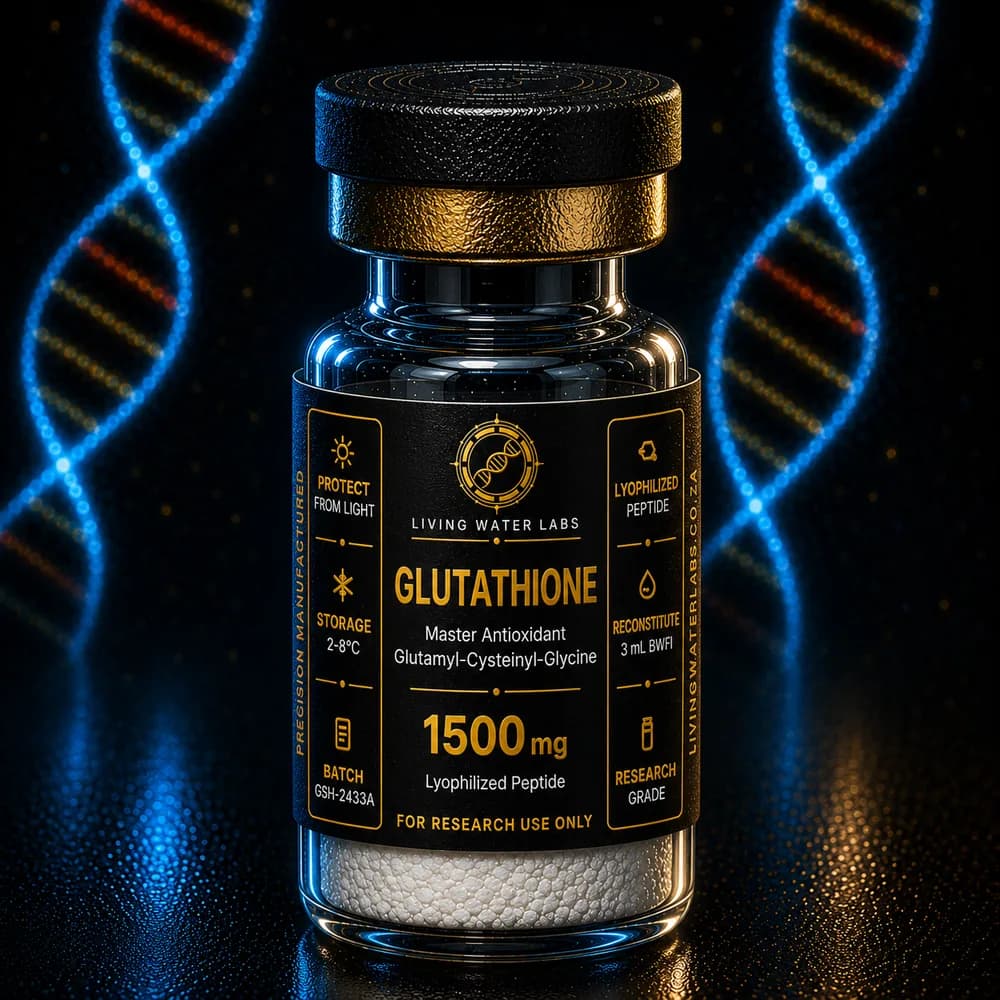
Research Overview
Antioxidant Tripeptide Research
Glutathione is the body’s principal endogenous antioxidant — a tripeptide (gamma-glutamyl-cysteinyl-glycine) that neutralises reactive oxygen species and supports phase-II detoxification and cellular redox balance.
Glutathione (Antioxidant Tripeptide Research) is a research-grade peptide supplied by Living Water Labs for laboratory investigation. Endogenous tripeptide (γ-Glu-Cys-Gly), 1500 mg lyophilised powder per vial.. Each published certificate is an independent Janoshik Analytical report naming the compound and its HPLC purity; certificates not yet published can be requested. The summary below outlines documented mechanisms and study areas reported in the research literature.
Scientific name
γ-L-Glutamyl-L-cysteinylglycine
Molecular weight
307.3 g/mol
Vial size
1500mg
Glutathione is the body’s principal endogenous antioxidant — a tripeptide (gamma-glutamyl-cysteinyl-glycine) that neutralises reactive oxygen species and supports phase-II detoxification and cellular redox balance. Research examines its metabolism and whether supplementation can raise the body’s glutathione stores.
J Nutr · 2004
A review of glutathione metabolism and its central role in antioxidant defence and detoxification.
View on PubMed (PMID 14988435)Eur J Nutr · 2015
A randomised controlled trial reporting that sustained oral glutathione supplementation raised body glutathione stores.
View on PubMed (PMID 24791752)Eur J Clin Nutr · 2018
A pilot trial reporting that oral liposomal glutathione elevated glutathione stores and some markers of immune function.
View on PubMed (PMID 28853742)Integr Med (Encinitas) · 2014
A concise clinical overview of glutathione physiological roles and research interest.
View on PubMed (PMID 26770075)Citations describe findings reported in the referenced preclinical, in-vitro or clinical literature. They are provided for research and educational purposes only and are not a therapeutic claim.
Both sides of cellular redox
Glutathione is the most abundant antioxidant inside cells and keeps oxidative damage in check. NAD+ is a redox coenzyme at the centre of energy metabolism. Researchers study them together because oxidative stress and falling NAD+ are two linked features of cellular ageing. This is the Vitality stack.
Reported research findings, mostly from cell and animal models. Not health claims; for research use only.
Related compounds: Mitochondrial & longevity research compounds in the compound encyclopedia.
All information is provided for research and educational purposes only and describes findings in preclinical/in-vitro literature. Not medical advice. Products are supplied strictly for research purposes — not for human consumption.
Keep exploring — goal collections, plain-language guides and the wellness journal, all in one place.
RESEARCH BY GOAL
GUIDES & TOOLS
Step-by-step guides — reconstitution, dosing, storage, handling and CoAs.
Explore →Work out exact bacteriostatic-water volumes for any vial — a free lab tool.
Explore →Per-compound overviews: documented mechanisms, study areas and cited literature.
Explore →Independent Janoshik Analytical certificates — compound identity and HPLC purity — published as styled summaries, the rest on request.
Explore →Purity, CoAs, storage, shipping and ordering — answered.
Explore →PEPTIDE GLOSSARY
Third-party lab documentation confirming a batch’s identity and purity.
Explore →High-performance liquid chromatography — the assay behind the purity figure on every published certificate.
Explore →Dissolving a lyophilised peptide in bacteriostatic water to a target concentration.
Explore →Freeze-dried to a stable powder for cold, dark, long-term storage.
Explore →Sterile water with 0.9% benzyl alcohol, used to reconstitute peptides.
Explore →Supplied strictly for laboratory research — not for human consumption.
Explore →FROM THE WELLNESS JOURNAL
2 min read · Cellular Health, Detox
Explore →7 min read · Peptides, Metabolic
Explore →9 min read · Peptides, Metabolic
Explore →Start from what you want to change rather than from a compound name. Every goal below opens a full vertical — what the research points to, what we stock for it, and how to run it.
Systemic wellness — the compounds most studied for how you age, recover overnight and feel day to day.
Training, recovery and tissue-repair research — for getting back to the gym, the field or the trail sooner.
Start from what you want to change — skin, hair, focus, mood, libido — and see what research points to.
Curated entry points for specific researchers — women, veterinary work, first-timers and bulk buyers.