Oxytocin vs Selank
Both have been researched for anxiety and social behaviour. Oxytocin is a native hormone with many intranasal trials and mixed results; selank is a synthetic peptide registered in Russia as an anxiolytic.
Oxytocin
The hypothalamic nonapeptide hormone of labour and lactation, and a major research focus in social behaviour.
BEST STUDIED FOR
Nootropic & neuro
Read the cited profile →
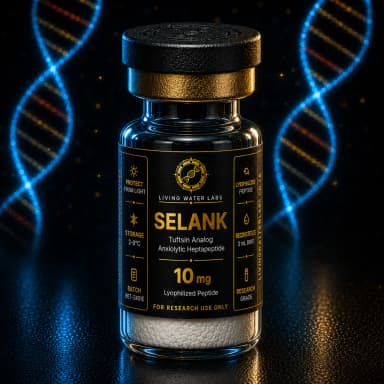
Selank
Selank is a synthetic heptapeptide analogue of the immunomodulatory peptide tuftsin.
BEST STUDIED FOR
Anxiolytic and immunomodulation models
R429View product →
Side by side · to buy
Price, purity and dispatch
| Compare | Oxytocin | Selank10mg |
|---|---|---|
| Price | — | R429 |
| Cost per mg | — | R42.9 / mg |
| Purity (Janoshik) | — | 99.604%HPLC, published |
| Stock | — | Restocking |
| Dispatch | — | When restocked |
| Certificate | — | View CoA → |
| Literature | 3 papers | 4 papers → |
| Research focus | Nootropic & neuro | Anxiolytic and immunomodulation models |
| Read the cited profile | Notify me |
Prices are read live from the catalogue. Cost per mg is the vial price over its stated mg. Purity is shown only where the certificate is published. Every compound is supplied for laboratory research only.
SIDE BY SIDE
| Oxytocin | Selank | |
|---|---|---|
| The key difference | Posterior-pituitary hormone | Synthetic tuftsin analogue |
| Class | Nootropic & neuro | Nootropic & neuro |
| Mechanism | Oxytocin is made in the hypothalamus and released from the posterior pituitary; it contracts the uterus and triggers milk let-down. | Selank is a synthetic heptapeptide analogue of the immunomodulatory peptide tuftsin. |
| Status | A registered prescription medicine for obstetric use. Intranasal research in autism and other conditions has produced mixed results, including a negative large trial in children with autism (2021). | Registered in Russia as a nasal anxiolytic; not approved elsewhere. |
| Reported safety signals | Obstetric use carries well-documented risks (uterine hyperstimulation, water intoxication at high doses). Intranasal research doses have been generally tolerated in trials. | Published human data come mainly from Russian clinical studies; no large Western trials. |
| A key study | A comprehensive review of oxytocin receptor signalling and its roles in reproduction and social behaviour. (Physiol Rev 2018, PMID 29897293) | A review of the molecular mechanisms proposed to underlie the anxiolytic-like activity of the heptapeptide Selank. (Protein Pept Lett 2018, PMID 30255741) |
WHEN TO RESEARCH WHICH
Oxytocin has the larger international literature; selank the Russian registration. Both are discussed here strictly as research compounds; nothing on this page is medical advice or a dosing guide.
REFERENCES (PUBMED)
- [Oxytocin] The Oxytocin Receptor: From Intracellular Signaling to Behavior — Physiol Rev 2018. PMID 29897293
- [Oxytocin] The Social Salience Hypothesis of Oxytocin — Biol Psychiatry 2016. PMID 26321019
- [Oxytocin] Intranasal Oxytocin in Children and Adolescents with Autism Spectrum Disorder — N Engl J Med 2021. PMID 34644471
- [Selank] Peptide-based Anxiolytics: The Molecular Aspects of Heptapeptide Selank Biological Activity — Protein Pept Lett 2018. PMID 30255741
- [Selank] Peptide Selank Enhances the Effect of Diazepam in Reducing Anxiety in Unpredictable Chronic Mild Stress — Behav Neurol 2017. PMID 28280289
- [Selank] Selank, Peptide Analogue of Tuftsin, Protects Against Ethanol-Induced Memory Impairment — Bull Exp Biol Med 2019. PMID 31625062
FREQUENTLY ASKED
What is the difference between Oxytocin and Selank?
Both have been researched for anxiety and social behaviour. Oxytocin is a native hormone with many intranasal trials and mixed results; selank is a synthetic peptide registered in Russia as an anxiolytic.
What is the regulatory status of Oxytocin and Selank?
Oxytocin: A registered prescription medicine for obstetric use. Intranasal research in autism and other conditions has produced mixed results, including a negative large trial in children with autism (2021). Selank: Registered in Russia as a nasal anxiolytic; not approved elsewhere.
What safety signals have been reported?
Oxytocin: Obstetric use carries well-documented risks (uterine hyperstimulation, water intoxication at high doses). Intranasal research doses have been generally tolerated in trials. Selank: Published human data come mainly from Russian clinical studies; no large Western trials.
Which studies is this comparison based on?
For Oxytocin: “The Oxytocin Receptor: From Intracellular Signaling to Behavior” (PMID 29897293); “The Social Salience Hypothesis of Oxytocin” (PMID 26321019); “Intranasal Oxytocin in Children and Adolescents with Autism Spectrum Disorder” (PMID 34644471). For Selank: “Peptide-based Anxiolytics: The Molecular Aspects of Heptapeptide Selank Biological Activity” (PMID 30255741); “Peptide Selank Enhances the Effect of Diazepam in Reducing Anxiety in Unpredictable Chronic Mild Stress” (PMID 28280289); “Selank, Peptide Analogue of Tuftsin, Protects Against Ethanol-Induced Memory Impairment” (PMID 31625062).
MORE COMPARISONS
All products supplied for research purposes only. Not for human consumption.
In stock · ships from South Africa
In stock now


Supplied for laboratory research only · not for human use