GHK-Cu vs Retinol
GHK-Cu and retinol are the two anti-ageing heavyweights in skin research, and they are compared because they reach a similar goal by opposite routes. Retinol forces cell turnover; GHK-Cu signals the skin to remodel its own collagen. One is potent but irritating, the other gentler but slower.
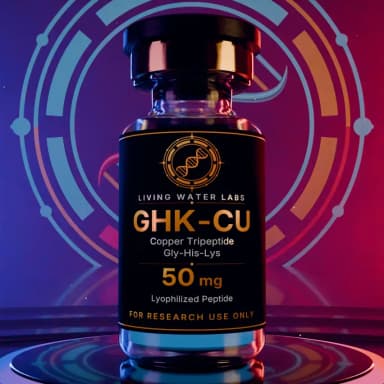
GHK-Cu
Copper tripeptide-1, studied for collagen signalling and dermal remodelling.
BEST STUDIED FOR
Gentle collagen-signalling research
R449View product →
Retinol
A vitamin-A derivative studied for driving skin-cell turnover.
BEST STUDIED FOR
Aggressive cell-turnover research
Explore skin research peptides →
SIDE BY SIDE
| GHK-Cu | Retinol | |
|---|---|---|
| Class | Copper-bound signalling tripeptide | Vitamin A derivative (retinoid) |
| Mechanism | Signals collagen synthesis and dermal remodelling | Forces keratinocyte turnover / differentiation |
| Irritation profile | Studied as gentle, well-tolerated | Well-known redness, flaking, sensitivity |
| Sun-sensitivity | Not associated with photosensitivity | Increases — night use advised |
| Also studied for | Wound healing, hair follicle, antioxidant activity | Fine lines, texture, pigmentation |
| Combined use | Can be layered with retinoids in research | Can be layered with peptides in research |
WHEN TO RESEARCH WHICH
Research GHK-Cu when the interest is collagen signalling and dermal remodelling with a gentler profile — it is not associated with the retinoid irritation or photosensitivity in the literature. Retinol remains the reference active where aggressive cell turnover is the goal and the irritation trade-off is acceptable. The two work by different mechanisms and are often studied as complements, not substitutes.
FREQUENTLY ASKED
What is the difference between GHK-Cu and retinol?
GHK-Cu is a copper peptide that signals the skin to synthesise and remodel collagen, with a gentle profile. Retinol is a vitamin-A derivative that forces cell turnover, which is effective but irritating and photosensitising. Different mechanisms, different trade-offs.
Is GHK-Cu gentler than retinol?
In the cosmetic-science literature GHK-Cu is studied as well-tolerated and is not associated with the redness, flaking and photosensitivity typical of retinoids, because it works through signalling rather than forced turnover. For research purposes only.
Can they be researched together?
Yes — they act through different mechanisms, so they are not mutually exclusive in research protocols and are often studied as complements. GHK-Cu is HPLC-verified with a Certificate of Analysis.
MORE COMPARISONS
All products supplied for research purposes only. Not for human consumption.