Relaxin vs TB-500 (Thymosin beta-4)
Both appear in fibrosis and cardiac research. Relaxin acts through the RXFP1 receptor (serelaxin was trialled in acute heart failure); TB-500 is a thymosin beta-4 fragment studied in tissue repair.
Relaxin
An insulin-family peptide hormone of pregnancy that remodels connective tissue, studied for anti-fibrotic and cardiovascular effects.
BEST STUDIED FOR
Repair & immune
Read the cited profile →
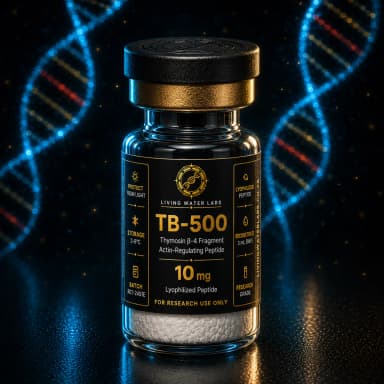
TB-500 (Thymosin beta-4)
Thymosin beta-4 — the parent molecule of the TB-500 fragment — is a naturally occurring 43-amino-acid actin-sequestering protein.
BEST STUDIED FOR
Cell-migration and tissue-repair models
R639View product →
Side by side · to buy
Price, purity and dispatch
| Compare | Relaxin | TB-500 (Thymosin beta-4)10mg |
|---|---|---|
| Price | — | R639 |
| Cost per mg | — | R63.9 / mg |
| Purity (Janoshik) | — | On request |
| Stock | — | Restocking |
| Dispatch | — | When restocked |
| Certificate | — | Request CoA |
| Literature | — | 4 papers → |
| Research focus | Repair & immune | Cell-migration and tissue-repair models |
| Read the cited profile | Notify me |
Prices are read live from the catalogue. Cost per mg is the vial price over its stated mg. Purity is shown only where the certificate is published. Every compound is supplied for laboratory research only.
SIDE BY SIDE
| Relaxin | TB-500 (Thymosin beta-4) | |
|---|---|---|
| The key difference | Pregnancy hormone; RXFP1 receptor | Thymosin β4 fragment; actin binding |
| Class | Repair & immune | Repair & immune |
| Mechanism | Relaxin acts at the RXFP1 receptor, increasing matrix-metalloproteinase activity and reducing collagen deposition — the basis of its ligament-relaxing role in pregnancy and its anti-fibrotic research. | Thymosin beta-4 — the parent molecule of the TB-500 fragment — is a naturally occurring 43-amino-acid actin-sequestering protein. |
| Status | Recombinant serelaxin was trialled in acute heart failure; research continues in fibrosis. Not an approved medicine. | Investigational synthetic fragment of thymosin beta-4; not an approved medicine. Most data come from thymosin beta-4 itself in animal models. |
| Reported safety signals | Systematic review data link relaxin levels to ACL-injury risk in female athletes, reflecting its collagen-loosening action. | No controlled human safety data for the fragment; thymosin beta-4 work is largely preclinical. |
| A key study | Reviews relaxin’s cardioprotective actions alongside its reproductive roles. (Mol Cell Endocrinol 2019, PMID 30625345) | A review outlining thymosin beta-4 actin-binding chemistry and its reported regenerative activity across cardiac, corneal and dermal repair models. (Expert Opin Biol Ther 2012, PMID 22074294) |
WHEN TO RESEARCH WHICH
Relaxin has human heart-failure trial data; TB-500 is mainly preclinical. Both are discussed here strictly as research compounds; nothing on this page is medical advice or a dosing guide.
REFERENCES (PUBMED)
- [Relaxin] Cardioprotective actions of relaxin — Mol Cell Endocrinol 2019. PMID 30625345
- [Relaxin] Relaxin as a treatment for musculoskeletal fibrosis: What we know and future directions — Biochem Pharmacol 2024. PMID 38729446
- [Relaxin] Menstrual Cycle Hormone Relaxin and ACL Injuries in Female Athletes: A Systematic Review — Iowa Orthop J 2024. PMID 38919370
- [TB-500 (Thymosin beta-4)] Thymosin beta4: a multi-functional regenerative peptide. Basic properties and clinical applications — Expert Opin Biol Ther 2012. PMID 22074294
- [TB-500 (Thymosin beta-4)] Thymosin beta 4 promotes corneal wound healing and decreases inflammation in vivo following alkali injury — Exp Eye Res 2002. PMID 11950239
- [TB-500 (Thymosin beta-4)] Thymosin beta 4 and the eye: the journey from bench to bedside — Expert Opin Biol Ther 2018. PMID 30063853
FREQUENTLY ASKED
What is the difference between Relaxin and TB-500 (Thymosin beta-4)?
Both appear in fibrosis and cardiac research. Relaxin acts through the RXFP1 receptor (serelaxin was trialled in acute heart failure); TB-500 is a thymosin beta-4 fragment studied in tissue repair.
What is the regulatory status of Relaxin and TB-500 (Thymosin beta-4)?
Relaxin: Recombinant serelaxin was trialled in acute heart failure; research continues in fibrosis. Not an approved medicine. TB-500 (Thymosin beta-4): Investigational synthetic fragment of thymosin beta-4; not an approved medicine. Most data come from thymosin beta-4 itself in animal models.
What safety signals have been reported?
Relaxin: Systematic review data link relaxin levels to ACL-injury risk in female athletes, reflecting its collagen-loosening action. TB-500 (Thymosin beta-4): No controlled human safety data for the fragment; thymosin beta-4 work is largely preclinical.
Which studies is this comparison based on?
For Relaxin: “Cardioprotective actions of relaxin” (PMID 30625345); “Relaxin as a treatment for musculoskeletal fibrosis: What we know and future directions” (PMID 38729446); “Menstrual Cycle Hormone Relaxin and ACL Injuries in Female Athletes: A Systematic Review” (PMID 38919370). For TB-500 (Thymosin beta-4): “Thymosin beta4: a multi-functional regenerative peptide. Basic properties and clinical applications” (PMID 22074294); “Thymosin beta 4 promotes corneal wound healing and decreases inflammation in vivo following alkali injury” (PMID 11950239); “Thymosin beta 4 and the eye: the journey from bench to bedside” (PMID 30063853).
MORE COMPARISONS
All products supplied for research purposes only. Not for human consumption.
In stock · ships from South Africa
In stock now


Supplied for laboratory research only · not for human use