15% offon your first order with code
◂ RESEARCH LIBRARY
🧬

Research Overview

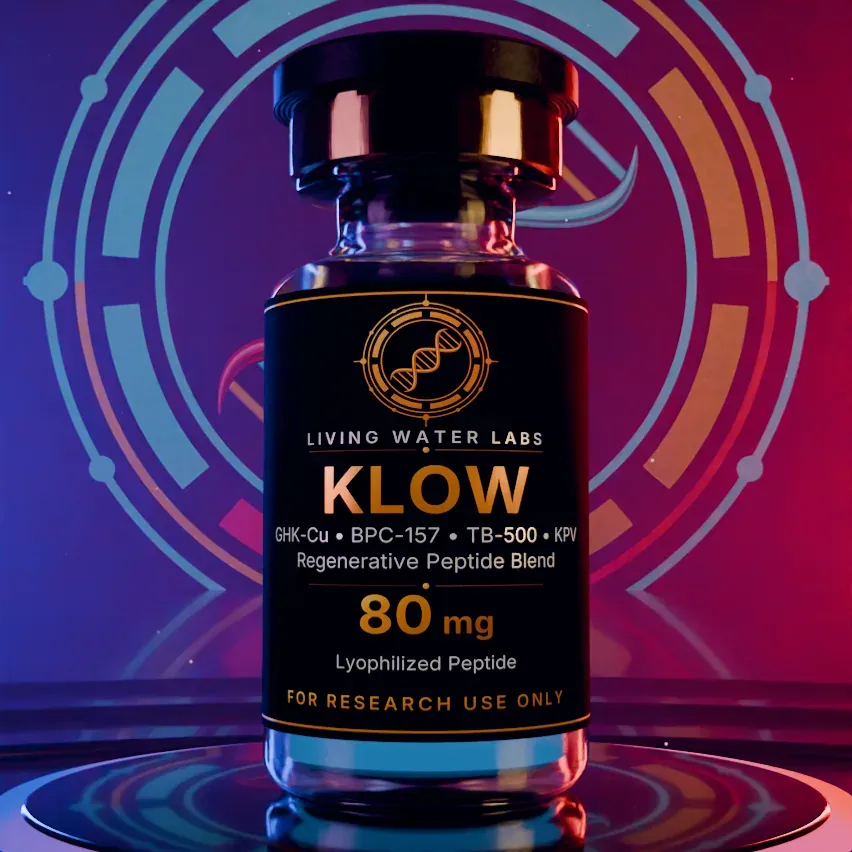
KLOW

Total-Body Renewal, One Vial

HPLC-verified 98%Batch CoAResearch use only

OVERVIEW

KLOW (Total-Body Renewal, One Vial) is a research-grade peptide supplied by Living Water Labs for laboratory investigation. Four regenerative peptides in one vial — recovery, skin and gut in a single draw. Each batch is HPLC-verified to a minimum 98% purity with a batch-specific Certificate of Analysis. The summary below outlines documented mechanisms and study areas reported in the research literature.

Scientific name

GHK-Cu 50mg · BPC-157 10mg · TB-500 10mg · KPV 10mg blend

Molecular weight

Blend (340.8 / 1419.5 / 4963.4 / 341.4 g/mol)

Purity

99.0%

Vial size

80mg

DOCUMENTED RESEARCH AREAS

  • Four regenerative peptides in a single reconstitution
  • Supports faster tissue repair and recovery
  • Firmer, smoother-looking skin and hair
  • Calms gut inflammation and eases flare-ups
  • Collagen and extracellular-matrix support
  • Complementary pathways, one daily draw

MECHANISM OF ACTION

KLOW is a blend rather than a single compound, and no published study has evaluated this specific four-peptide combination — the evidence below is the literature for each constituent, cited separately. The rationale for combining them is that they are studied along four distinct pathways in the same repair models: GHK-Cu as a copper carrier and gene-expression modulator affecting extracellular-matrix remodelling; BPC-157 through nitric-oxide and angiogenic signalling in connective tissue; TB-500 (thymosin beta-4) through actin sequestration and cell migration; and KPV through PepT1-mediated uptake and dampened NF-kB inflammatory signalling.

  • GHK-Cu — modulates collagen synthesis and matrix-metalloproteinase activity in skin and wound models
  • BPC-157 — modulates nitric-oxide and angiogenic (VEGFR2) pathways in preclinical tissue repair
  • TB-500 — sequesters G-actin, regulating cytoskeletal assembly and cell motility
  • KPV — enters cells via PepT1 and inhibits NF-kB pro-inflammatory signalling
  • No study has tested the four together; combination effects are unestablished

STUDY SUMMARIES

6 peer-reviewed references

Biomed Res Int · 2015

GHK Peptide as a Natural Modulator of Multiple Cellular Pathways in Skin Regeneration

A review describing GHK modulation of multiple gene-expression and signalling pathways involved in skin regeneration.

View on PubMed (PMID 26236730)

J Invest Dermatol · 1999

Expression and activation of matrix metalloproteinases in wounds: modulation by the tripeptide-copper complex glycyl-L-histidyl-L-lysine-Cu2+

In experimental wounds, the GHK-copper complex modulated expression and activation of matrix metalloproteinases involved in tissue remodelling.

View on PubMed (PMID 10383745)

J Appl Physiol (1985) · 2011

The promoting effect of pentadecapeptide BPC 157 on tendon healing involves tendon outgrowth, cell survival, and cell migration

In cultured tendon fibroblasts, BPC-157 increased cell survival, outgrowth and migration in vitro.

View on PubMed (PMID 21030672)

Cell Tissue Res · 2019

Gastric pentadecapeptide body protection compound BPC 157 and its role in accelerating musculoskeletal soft tissue healing

A review of preclinical data describing BPC-157 in the healing of muscle, tendon, ligament and other soft tissues in animal models.

View on PubMed (PMID 30915550)

Expert Opin Biol Ther · 2012

Thymosin beta4: a multi-functional regenerative peptide. Basic properties and clinical applications

A review outlining thymosin beta-4 actin-binding chemistry and its reported regenerative activity across cardiac, corneal and dermal repair models.

View on PubMed (PMID 22074294)

Gastroenterology · 2008

PepT1-mediated tripeptide KPV uptake reduces intestinal inflammation

PepT1-mediated uptake of KPV reduced intestinal inflammation and pro-inflammatory signalling in cell and mouse models.

View on PubMed (PMID 18061177)

CITATIONS

  1. 1.GHK Peptide as a Natural Modulator of Multiple Cellular Pathways in Skin Regeneration. Biomed Res Int. 2015. PMID 26236730. pubmed.ncbi.nlm.nih.gov/26236730
  2. 2.Expression and activation of matrix metalloproteinases in wounds: modulation by the tripeptide-copper complex glycyl-L-histidyl-L-lysine-Cu2+. J Invest Dermatol. 1999. PMID 10383745. pubmed.ncbi.nlm.nih.gov/10383745
  3. 3.The promoting effect of pentadecapeptide BPC 157 on tendon healing involves tendon outgrowth, cell survival, and cell migration. J Appl Physiol (1985). 2011. PMID 21030672. pubmed.ncbi.nlm.nih.gov/21030672
  4. 4.Gastric pentadecapeptide body protection compound BPC 157 and its role in accelerating musculoskeletal soft tissue healing. Cell Tissue Res. 2019. PMID 30915550. pubmed.ncbi.nlm.nih.gov/30915550
  5. 5.Thymosin beta4: a multi-functional regenerative peptide. Basic properties and clinical applications. Expert Opin Biol Ther. 2012. PMID 22074294. pubmed.ncbi.nlm.nih.gov/22074294
  6. 6.PepT1-mediated tripeptide KPV uptake reduces intestinal inflammation. Gastroenterology. 2008. PMID 18061177. pubmed.ncbi.nlm.nih.gov/18061177

Citations describe findings reported in the referenced preclinical, in-vitro or clinical literature. They are provided for research and educational purposes only and are not a therapeutic claim.

All information is provided for research and educational purposes only and describes findings in preclinical/in-vitro literature. Not medical advice. Products are supplied strictly for research purposes — not for human consumption.

Related Research & Reading

Keep exploring — goal collections, plain-language guides and the wellness journal, all in one place.