DSIP vs Epitalon
DSIP was isolated in 1977 from rabbits after it increased delta-wave sleep on infusion, but its receptor is still unknown. Epitalon comes from pineal-gland research and is studied for melatonin rhythm and ageing markers rather than for sleep induction itself.
DSIP
A nonapeptide (Trp-Ala-Gly-Gly-Asp-Ala-Ser-Gly-Glu) isolated in 1977 from rabbit cerebral venous blood during studies of sleep.
BEST STUDIED FOR
Nootropic & neuro
Read the cited profile →
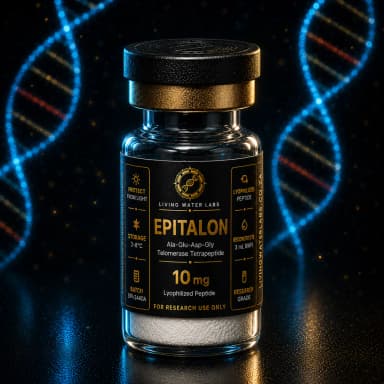
Epitalon
Epitalon (epithalon) is a synthetic tetrapeptide (Ala-Glu-Asp-Gly) modelled on the pineal peptide epithalamin.
BEST STUDIED FOR
Telomerase and pineal-ageing models
R549View product →
Side by side · to buy
Price, purity and dispatch
| Compare | DSIP | Epitalon10mg |
|---|---|---|
| Price | — | R549 |
| Cost per mg | — | R54.9 / mg |
| Purity (Janoshik) | — | On request |
| Stock | — | Restocking |
| Dispatch | — | When restocked |
| Certificate | — | Request CoA |
| Literature | 4 papers | 4 papers → |
| Research focus | Nootropic & neuro | Telomerase and pineal-ageing models |
| Read the cited profile | Notify me |
Prices are read live from the catalogue. Cost per mg is the vial price over its stated mg. Purity is shown only where the certificate is published. Every compound is supplied for laboratory research only.
SIDE BY SIDE
| DSIP | Epitalon | |
|---|---|---|
| The key difference | Proposed sleep-promoting nonapeptide | Pineal-derived tetrapeptide |
| Class | Nootropic & neuro | Bioregulators |
| Mechanism | DSIP was named for enhancing slow-wave (delta) EEG activity after brain infusion in rabbits. | Epitalon (epithalon) is a synthetic tetrapeptide (Ala-Glu-Asp-Gly) modelled on the pineal peptide epithalamin. |
| Status | Studied in the 1980s in small human sleep studies; no approved medicine and little modern research. | A synthetic tetrapeptide from the Khavinson bioregulator programme; not an approved medicine. |
| Reported safety signals | Older small studies reported no major issues; data are too limited to characterise safety. | Human data are limited to small studies, mostly from one research group. |
| A key study | The isolation paper: a peptide enhancing delta EEG after brain infusion in rabbits, with its amino-acid sequence. (Proc Natl Acad Sci U S A 1977, PMID 265572) | In cultured human somatic cells, epithalon induced telomerase activity and elongation of telomeres. (Bull Exp Biol Med 2003, PMID 12937682) |
WHEN TO RESEARCH WHICH
DSIP for slow-wave sleep research; Epitalon for pineal and circadian-ageing research. Both are discussed here strictly as research compounds; nothing on this page is medical advice or a dosing guide.
REFERENCES (PUBMED)
- [DSIP] Characterization of a delta-electroencephalogram (-sleep)-inducing peptide — Proc Natl Acad Sci U S A 1977. PMID 265572
- [DSIP] Delta sleep-inducing peptide (DSIP): a still unresolved riddle — J Neurochem 2006. PMID 16539679
- [DSIP] DSIP in sleep disturbances — Eur Neurol 1986. PMID 3758119
- [Epitalon] Epithalon peptide induces telomerase activity and telomere elongation in human somatic cells — Bull Exp Biol Med 2003. PMID 12937682
- [Epitalon] Peptide promotes overcoming of the division limit in human somatic cell — Bull Exp Biol Med 2004. PMID 15455129
- [Epitalon] Effect of regulatory peptides on gene transcription — Bull Exp Biol Med 2003. PMID 14666197
FREQUENTLY ASKED
What is the difference between DSIP and Epitalon?
DSIP was isolated in 1977 from rabbits after it increased delta-wave sleep on infusion, but its receptor is still unknown. Epitalon comes from pineal-gland research and is studied for melatonin rhythm and ageing markers rather than for sleep induction itself.
What is the regulatory status of DSIP and Epitalon?
DSIP: Studied in the 1980s in small human sleep studies; no approved medicine and little modern research. Epitalon: A synthetic tetrapeptide from the Khavinson bioregulator programme; not an approved medicine.
What safety signals have been reported?
DSIP: Older small studies reported no major issues; data are too limited to characterise safety. Epitalon: Human data are limited to small studies, mostly from one research group.
Which studies is this comparison based on?
For DSIP: “Characterization of a delta-electroencephalogram (-sleep)-inducing peptide” (PMID 265572); “Delta sleep-inducing peptide (DSIP): a still unresolved riddle” (PMID 16539679); “DSIP in sleep disturbances” (PMID 3758119). For Epitalon: “Epithalon peptide induces telomerase activity and telomere elongation in human somatic cells” (PMID 12937682); “Peptide promotes overcoming of the division limit in human somatic cell” (PMID 15455129); “Effect of regulatory peptides on gene transcription” (PMID 14666197).
MORE COMPARISONS
All products supplied for research purposes only. Not for human consumption.
In stock · ships from South Africa
In stock now


Supplied for laboratory research only · not for human use