SS-31 vs MOTS-c
Both are tied to mitochondria differently. SS-31 (elamipretide) is a synthetic peptide that binds cardiolipin in the inner mitochondrial membrane; MOTS-c is encoded by mitochondrial DNA and acts as a signalling peptide.
SS-31
A mitochondria-targeted tetrapeptide that binds cardiolipin in the inner mitochondrial membrane — approved in the US in 2025 for Barth syndrome.
BEST STUDIED FOR
Mitochondrial & longevity
Read the cited profile →
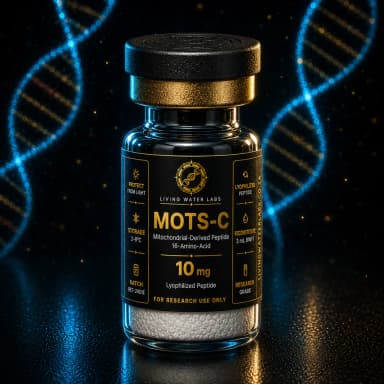
MOTS-c
MOTS-c is a mitochondrial-derived peptide encoded within the 12S rRNA region of mitochondrial DNA.
BEST STUDIED FOR
Metabolic and exercise-mimetic models
R429View product →
Side by side · to buy
Price, purity and dispatch
| Compare | SS-31 | MOTS-c10 mg · more sizes |
|---|---|---|
| Price | — | fromR429 |
| Cost per mg | — | R42.9 / mg |
| Purity (Janoshik) | — | 99.229%HPLC, published |
| Stock | — | Restocking |
| Dispatch | — | When restocked |
| Certificate | — | View CoA → |
| Literature | 4 papers | 4 papers → |
| Research focus | Mitochondrial & longevity | Metabolic and exercise-mimetic models |
| Read the cited profile | Notify me |
Prices are read live from the catalogue. Cost per mg is the vial price over its stated mg. Purity is shown only where the certificate is published. Every compound is supplied for laboratory research only.
SIDE BY SIDE
| SS-31 | MOTS-c | |
|---|---|---|
| The key difference | Cardiolipin-targeting tetrapeptide | Mitochondrial-DNA-encoded peptide |
| Class | Mitochondrial & longevity | Mitochondrial & longevity |
| Mechanism | SS-31 concentrates in the inner mitochondrial membrane and binds cardiolipin, the lipid that holds the electron-transport chain together. | MOTS-c is a mitochondrial-derived peptide encoded within the 12S rRNA region of mitochondrial DNA. |
| Status | Accelerated US approval (September 2025) to improve muscle strength in Barth syndrome; further trials in other mitochondrial disorders. | Investigational mitochondrial-derived peptide; not an approved medicine. |
| Reported safety signals | Clinical programmes report injection-site reactions as the most common effect. | Human data are limited to early-stage work; most findings are from rodent metabolic models. |
| A key study | Summarises the September 2025 US accelerated approval of elamipretide for muscle strength in Barth syndrome. (Drugs 2026, PMID 41335372) | The discovery study reporting that MOTS-c activates AMPK and improved metabolic homeostasis and insulin sensitivity in mice. (Cell Metab 2015, PMID 25738459) |
WHEN TO RESEARCH WHICH
SS-31 has human trials (including Barth syndrome); MOTS-c mostly animal data. Both are discussed here strictly as research compounds; nothing on this page is medical advice or a dosing guide.
REFERENCES (PUBMED)
- [SS-31] Elamipretide: First Approval — Drugs 2026. PMID 41335372
- [SS-31] Elamipretide: A Review of Its Structure, Mechanism of Action, and Therapeutic Potential — Int J Mol Sci 2025. PMID 39940712
- [SS-31] The mitochondrial-targeted compound SS-31 re-energizes ischemic mitochondria by interacting with cardiolipin — J Am Soc Nephrol 2013. PMID 23813215
- [MOTS-c] The mitochondrial-derived peptide MOTS-c promotes metabolic homeostasis and reduces obesity and insulin resistance — Cell Metab 2015. PMID 25738459
- [MOTS-c] MOTS-c: A novel mitochondrial-derived peptide regulating muscle and fat metabolism — Free Radic Biol Med 2016. PMID 27216708
- [MOTS-c] MOTS-c: A promising mitochondrial-derived peptide for therapeutic exploitation — Front Endocrinol (Lausanne) 2023. PMID 36761202
FREQUENTLY ASKED
What is the difference between SS-31 and MOTS-c?
Both are tied to mitochondria differently. SS-31 (elamipretide) is a synthetic peptide that binds cardiolipin in the inner mitochondrial membrane; MOTS-c is encoded by mitochondrial DNA and acts as a signalling peptide.
What is the regulatory status of SS-31 and MOTS-c?
SS-31: Accelerated US approval (September 2025) to improve muscle strength in Barth syndrome; further trials in other mitochondrial disorders. MOTS-c: Investigational mitochondrial-derived peptide; not an approved medicine.
What safety signals have been reported?
SS-31: Clinical programmes report injection-site reactions as the most common effect. MOTS-c: Human data are limited to early-stage work; most findings are from rodent metabolic models.
Which studies is this comparison based on?
For SS-31: “Elamipretide: First Approval” (PMID 41335372); “Elamipretide: A Review of Its Structure, Mechanism of Action, and Therapeutic Potential” (PMID 39940712); “The mitochondrial-targeted compound SS-31 re-energizes ischemic mitochondria by interacting with cardiolipin” (PMID 23813215). For MOTS-c: “The mitochondrial-derived peptide MOTS-c promotes metabolic homeostasis and reduces obesity and insulin resistance” (PMID 25738459); “MOTS-c: A novel mitochondrial-derived peptide regulating muscle and fat metabolism” (PMID 27216708); “MOTS-c: A promising mitochondrial-derived peptide for therapeutic exploitation” (PMID 36761202).
MORE COMPARISONS
All products supplied for research purposes only. Not for human consumption.
In stock · ships from South Africa
In stock now






Supplied for laboratory research only · not for human use