Tesamorelin vs MOTS-c
Tesamorelin and MOTS-c are both studied for metabolism, which is why they are compared — but they reach metabolic effects by entirely different routes. Tesamorelin works through the growth-hormone axis and has a visceral-fat literature; MOTS-c is a mitochondrial peptide that signals through AMPK.
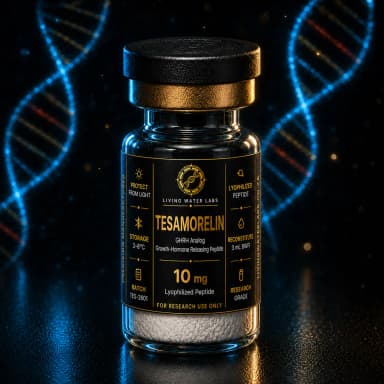
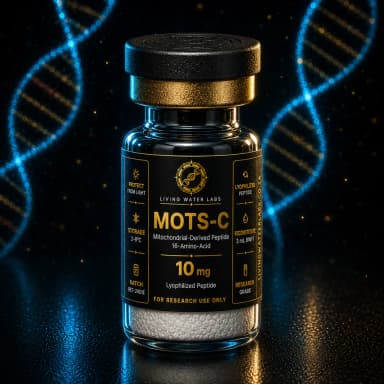
SIDE BY SIDE
| Tesamorelin | MOTS-c | |
|---|---|---|
| Class | GHRH analog | Mitochondrial-derived peptide |
| Mechanism | Prompts endogenous GH release via GHRH receptor | AMPK activation and mitochondrial metabolic signalling |
| Metabolic angle | Visceral adipose tissue, IGF-1 downstream effects | Insulin sensitivity, glucose handling, exercise mimetic |
| Pathway | Growth-hormone axis | Mitochondrial signalling |
| Research focus | GH-driven metabolic parameters | Cellular metabolism and energy |
| Overlap | Metabolic regulation | Metabolic regulation |
WHEN TO RESEARCH WHICH
Research Tesamorelin when the interest is the GH axis and its downstream metabolic and visceral-adipose research. Research MOTS-c when the interest is mitochondrial metabolic signalling — AMPK activation, glucose handling and exercise-mimetic effects. Both are metabolic peptides, but one operates via endogenous GH release and the other directly at the mitochondria.
FREQUENTLY ASKED
What is the difference between Tesamorelin and MOTS-c?
Tesamorelin is a GHRH analog that acts through the growth-hormone axis, with a visceral-fat literature. MOTS-c is a mitochondrial-derived peptide that signals through AMPK for metabolic regulation. Both are metabolic, but one works via GH release and the other at the mitochondria.
Can Tesamorelin and MOTS-c be researched together?
They approach metabolism through separate pathways — GH axis vs mitochondrial signalling — so they are sometimes studied in parallel. Both are supplied for research purposes only.
Which acts on the mitochondria?
MOTS-c is the mitochondrial-derived peptide acting via AMPK; Tesamorelin acts through the growth-hormone axis. Both are HPLC-verified with a Certificate of Analysis.
MORE COMPARISONS
All products supplied for research purposes only. Not for human consumption.