Methylene Blue vs MOTS-c
Methylene blue and MOTS-c are both studied for mitochondrial function and cellular energy, which is why they are compared — but they engage the mitochondria in completely different ways. Methylene blue acts directly in the electron transport chain; MOTS-c is a signalling peptide encoded within the mitochondrial genome itself.
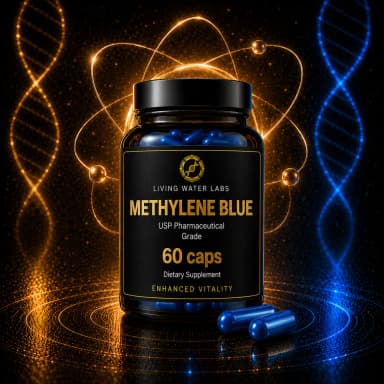
Methylene Blue
A phenothiazine dye studied as an alternative electron carrier in the mitochondria.
BEST STUDIED FOR
Direct mitochondrial-energy & cognition research
R239View product →
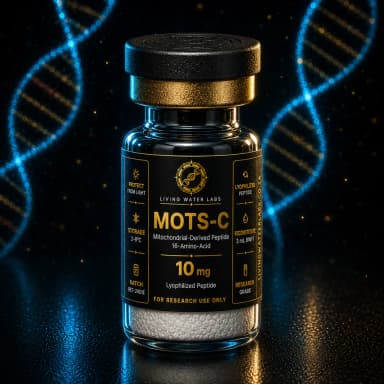
MOTS-c
A mitochondrial-derived signalling peptide studied for metabolic regulation.
BEST STUDIED FOR
Mitochondrial-signalling & metabolic research
R420View product →
SIDE BY SIDE
| Methylene Blue | MOTS-c | |
|---|---|---|
| Type | Phenothiazine dye (small molecule) | Mitochondrial-derived peptide (16 amino acids) |
| Mechanism | Alternative electron carrier in the electron transport chain | AMPK activation and metabolic signalling |
| Research focus | Cellular energy, cognition, antioxidant defence | Metabolism, insulin sensitivity, exercise mimetic |
| Origin | Synthetic | Encoded within mitochondrial 12S rRNA |
| Role | Participates directly in ATP production | Signals to regulate metabolism |
| Overlap | Mitochondrial / cellular energy | Mitochondrial / cellular energy |
WHEN TO RESEARCH WHICH
Research methylene blue when the interest is direct support of mitochondrial electron transport and its cognition and energy literature. Research MOTS-c when the interest is mitochondrial signalling — AMPK activation, glucose handling and exercise-mimetic effects. One is a redox participant in the ATP machinery; the other is a metabolic messenger.
FREQUENTLY ASKED
What is the difference between methylene blue and MOTS-c?
Methylene blue is a dye that acts directly in the mitochondrial electron transport chain as an alternative electron carrier. MOTS-c is a peptide encoded within the mitochondrial genome that acts as a metabolic signal (AMPK). One participates in ATP production, the other regulates metabolism.
Can methylene blue and MOTS-c be researched together?
They approach mitochondrial biology from different angles — direct electron transport vs metabolic signalling — so they are sometimes studied in parallel in cellular-energy research. Both are for research purposes only.
Is MOTS-c a peptide and methylene blue not?
Correct — MOTS-c is a mitochondrial-derived peptide, while methylene blue is a phenothiazine dye, not a peptide. Both are HPLC-verified / CoA-certified and supplied for research purposes only.
MORE COMPARISONS
All products supplied for research purposes only. Not for human consumption.