Vesugen vs Pinealon
Vesugen (Lys-Glu-Asp) is studied for blood-vessel tissue; pinealon (Glu-Asp-Arg) for neurons. Both are short synthetic bioregulators.
Vesugen
A synthetic tripeptide bioregulator associated with vascular endothelium in the Khavinson programme.
BEST STUDIED FOR
Bioregulators
Read the cited profile →
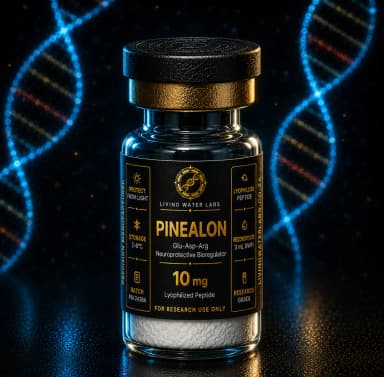
Pinealon
Pinealon is a synthetic tripeptide (Glu-Asp-Arg, "EDR") among the Khavinson peptide bioregulators.
BEST STUDIED FOR
Neuronal-protection models
R429View product →
Side by side · to buy
Price, purity and dispatch
| Compare | Vesugen | Pinealon10mg |
|---|---|---|
| Price | — | R429 |
| Cost per mg | — | R42.9 / mg |
| Purity (Janoshik) | — | On request |
| Stock | — | Restocking |
| Dispatch | — | When restocked |
| Certificate | — | Request CoA |
| Literature | — | 2 papers → |
| Research focus | Bioregulators | Neuronal-protection models |
| Read the cited profile | Notify me |
Prices are read live from the catalogue. Cost per mg is the vial price over its stated mg. Purity is shown only where the certificate is published. Every compound is supplied for laboratory research only.
SIDE BY SIDE
| Vesugen | Pinealon | |
|---|---|---|
| The key difference | Vascular-associated tripeptide | Brain-associated tripeptide |
| Class | Bioregulators | Bioregulators |
| Mechanism | Reported to stimulate proliferation markers (Ki-67) in vascular endothelial cell cultures from aged animals and to influence neuronal differentiation genes; as with related peptides, attributed to gene-expression regulation. | Pinealon is a synthetic tripeptide (Glu-Asp-Arg, "EDR") among the Khavinson peptide bioregulators. |
| Status | Cell, animal and small uncontrolled human studies from one research group. | A synthetic tripeptide bioregulator; not an approved medicine. |
| Reported safety signals | No independent human safety data. | No controlled human safety data; findings are from cell and animal models. |
| A key study | Vesugen stimulated the proliferation marker Ki-67 in vascular endothelial cultures from young and old animals. (Adv Gerontol 2014, PMID 25051766) | In cell studies, Pinealon increased cell viability by suppressing free-radical levels and activating proliferation. (Rejuvenation Res 2011, PMID 21978084) |
WHEN TO RESEARCH WHICH
Vesugen for vascular models; pinealon for neuronal models. Both are discussed here strictly as research compounds; nothing on this page is medical advice or a dosing guide.
REFERENCES (PUBMED)
- [Vesugen] [Epigenetic aspects of peptidergic regulation of vascular endothelial cell proliferation during aging] — Adv Gerontol 2014. PMID 25051766
- [Vesugen] [Investigation of antihypoxic properties of short peptides] — Adv Gerontol 2008. PMID 18546825
- [Vesugen] Peptide KED: Molecular-Genetic Aspects of Neurogenesis Regulation in Alzheimer’s Disease — Bull Exp Biol Med 2021. PMID 34173097
- [Pinealon] Pinealon increases cell viability by suppression of free radical levels and activating proliferative processes — Rejuvenation Res 2011. PMID 21978084
- [Pinealon] EDR Peptide: Possible Mechanism of Gene Expression and Protein Synthesis Regulation Involved in the Pathogenesis of Alzheimer’s Disease — Molecules 2020. PMID 33396470
FREQUENTLY ASKED
What is the difference between Vesugen and Pinealon?
Vesugen (Lys-Glu-Asp) is studied for blood-vessel tissue; pinealon (Glu-Asp-Arg) for neurons. Both are short synthetic bioregulators.
What is the regulatory status of Vesugen and Pinealon?
Vesugen: Cell, animal and small uncontrolled human studies from one research group. Pinealon: A synthetic tripeptide bioregulator; not an approved medicine.
What safety signals have been reported?
Vesugen: No independent human safety data. Pinealon: No controlled human safety data; findings are from cell and animal models.
Which studies is this comparison based on?
For Vesugen: “[Epigenetic aspects of peptidergic regulation of vascular endothelial cell proliferation during aging]” (PMID 25051766); “[Investigation of antihypoxic properties of short peptides]” (PMID 18546825); “Peptide KED: Molecular-Genetic Aspects of Neurogenesis Regulation in Alzheimer’s Disease” (PMID 34173097). For Pinealon: “Pinealon increases cell viability by suppression of free radical levels and activating proliferative processes” (PMID 21978084); “EDR Peptide: Possible Mechanism of Gene Expression and Protein Synthesis Regulation Involved in the Pathogenesis of Alzheimer’s Disease” (PMID 33396470).
MORE COMPARISONS
All products supplied for research purposes only. Not for human consumption.
In stock · ships from South Africa
In stock now


Supplied for laboratory research only · not for human use