Tesamorelin vs Sermorelin
Tesamorelin and Sermorelin are two GHRH analogs, so the comparison is within one family — both prompt the pituitary via the GHRH receptor. The difference is stability and research focus: Sermorelin closely mimics native GHRH with a very short action, while Tesamorelin is stabilised and carries a visceral-fat literature.
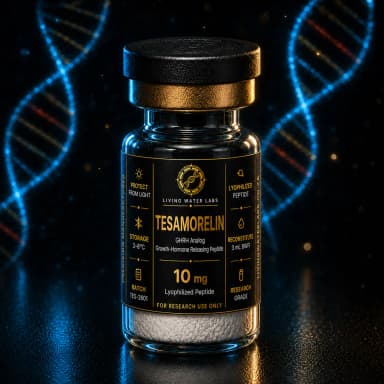
Tesamorelin
A stabilised GHRH analog studied for endogenous GH release and visceral fat.
BEST STUDIED FOR
Stabilised, metabolic GHRH research
R1 369View product →
Sermorelin
A GHRH(1-29) analog that closely mimics native GHRH kinetics.
BEST STUDIED FOR
Native-like GHRH-pulse research
Explore GH research peptides →
SIDE BY SIDE
| Tesamorelin | Sermorelin | |
|---|---|---|
| Class | GHRH analog (stabilised) | GHRH analog (GHRH 1-29) |
| Structure | Modified GHRH for improved stability | The first 29 residues of native GHRH |
| Half-life | Longer — stabilised | Very short — native-like |
| Distinctive research focus | Visceral adipose tissue, metabolic parameters | General GH-axis / physiological release |
| Receptor | GHRH receptor | GHRH receptor |
| Commonly paired with | A secretagogue such as Ipamorelin | A secretagogue such as Ipamorelin |
WHEN TO RESEARCH WHICH
Research Sermorelin when the interest is a GHRH(1-29) analog that mimics native GHRH kinetics with a very short half-life. Research Tesamorelin when the interest is a stabilised GHRH analog with a longer action and a distinctive visceral-adipose and metabolic research profile. Same GHRH pathway; the trade-off is native-like brevity vs engineered stability. We stock Tesamorelin; Sermorelin is a reference here.
FREQUENTLY ASKED
What is the difference between Tesamorelin and Sermorelin?
Both are GHRH analogs. Sermorelin is a GHRH(1-29) analog that closely mimics native GHRH with a very short half-life; Tesamorelin is a stabilised analog with a longer action and a distinctive visceral-fat literature. Same pathway, different stability and focus.
Which is more stable?
Tesamorelin is the stabilised analog with a longer half-life, whereas Sermorelin mimics the brief kinetics of native GHRH. Tesamorelin is supplied for research purposes only.
Do you stock both?
We stock Tesamorelin, HPLC-verified with a Certificate of Analysis. Sermorelin appears here as a reference comparison; browse our GH research range for current stock.
MORE COMPARISONS
All products supplied for research purposes only. Not for human consumption.