Sport research · Cricket

Peptides for cricket: fast bowlers, long days and recovery

Cricket looks gentle from the stands, but fast bowling is one of the most punishing repetitive actions in sport. This page maps the game’s real demands — bowling load, heat, focus over five days — onto the published research.

Low-contact sportWADA 2026 status checkedVerified PubMed citations

Tested athletes: read this first

Under the WADA 2026 Prohibited List (in force from 1 January 2026), BPC-157 is named under S0, TB-500 under S2.3, Ipamorelin and Tesamorelin under S2.2.4 and MOTS-c under S4.4.1 — all prohibited in and out of competition. Research peptides with no regulatory approval anywhere are caught by S0’s catch-all wording. Tested athletes: these are banned. South African athletes can check with SAIDS and the official 2026 List.

The demands

What cricket asks of the body

The injury profile of cricket is dominated by fast bowlers. The delivery stride puts several times bodyweight through the front leg and forces the lumbar spine into combined extension, side-bend and rotation, which is why lumbar stress fractures are the classic injury of young quicks and why workload monitoring is now standard in every professional set-up. Side strains, shoulder overuse and hamstring injuries follow.

Batters and fielders face a different mix: hours of concentration, quick reactions and occasional high-speed collisions or ball strikes. Head impact from a bouncer is rare but serious enough that concussion substitutes are now allowed in international cricket.

South Africa plays in some of the hottest, highest-UV conditions in world cricket, from Centurion in summer to the Highveld altitude of the Wanderers. CSA applies the ICC anti-doping code, which is WADA-compliant, so the anti-doping section below covers franchise, provincial and national players alike.

Mapped to the evidence radar

Each demand below is mapped to one of the ten fixed research areas on our evidence radar. The heavier the weight, the more that area counts when compounds are ranked for Cricket: Recovery & Repair ×3, Cognition & Focus ×2, Sleep & Recovery Rhythm ×2, Skin, Hair & Glow ×1, Longevity & Energy ×1.

  • Bowling workload · Recovery & Repair
    Lumbar bone stress, side strains and shoulder overuse. Repair research in the catalogue is preclinical; bone-stress research is thin across the board.
  • Concentration over long days · Cognition & Focus
    Test cricket asks for focus across five days. The Cognition axis draws on Russian clinical Semax/Selank research and Western trials in patient populations.
  • Multi-day matches and travel · Sleep & Recovery Rhythm
    Touring schedules and day-night matches disrupt sleep. Pineal-bioregulator sleep research is in older adults, stated plainly.
  • Sun exposure · Skin, Hair & Glow
    Long days in high UV. Skin-axis research (GHK-Cu, glutathione) is cosmetic-science and small human trials — nothing here is sun protection.
By the evidence

Highest-scoring compounds for Cricket

Ranked by weighted evidence score across Cricket’s research areas. A reading aid for the literature — not a recommendation, and not a performance claim.

Fat LossAppetiteMuscleRepairSkin & HairGut & ImmuneCognitionMoodSleepLongevityKLOWCerebrolysinEpitalon
Top three for Cricket, overlaid · strength of published evidence per area
Show the scores as a table
Evidence score per research area, 0 to 10
AreaKLOWCerebrolysinEpitalon
Fat Loss & Metabolism212
Appetite Control111
Muscle & Body Composition623
Recovery & Repair1085
Skin, Hair & Glow1036
Gut & Immune1045
Cognition & Focus6106
Mood & Calm565
Sleep & Recovery Rhythm359
Longevity & Energy9610

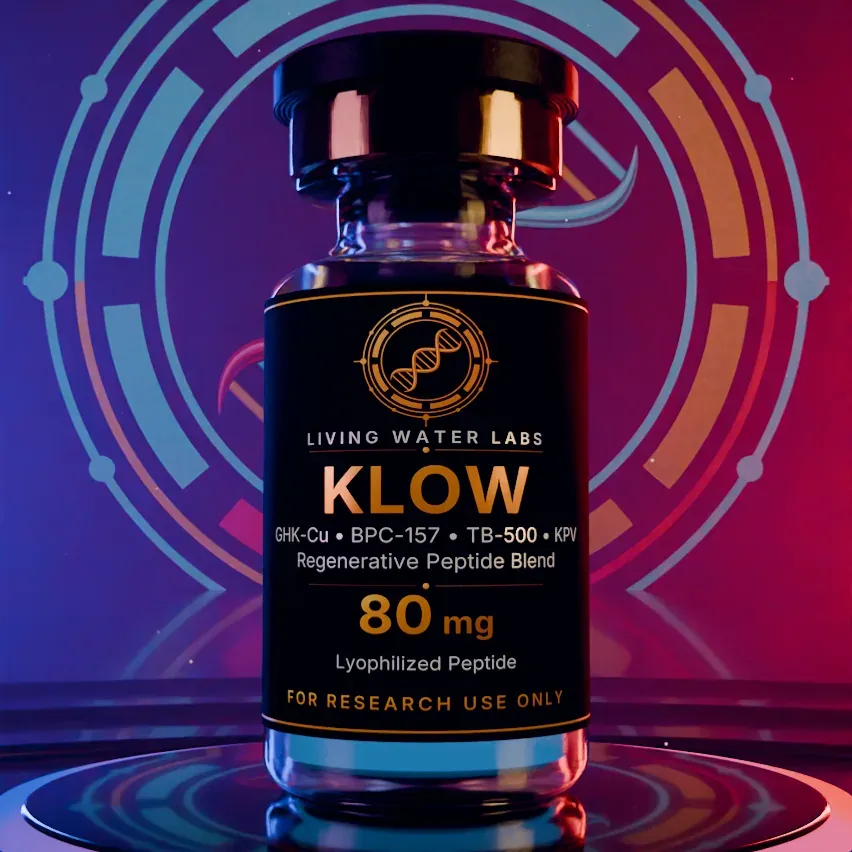
KLOW

In stock
7.4Cricket match
Recovery & RepairPrimary10/10

Extensive animal and tissue studies demonstrate rapid healing of tendon, ligament, muscle, and bone.

Cognition & Focus6/10

Copper chaperoning supports neurovascular integrity and dampens neuroinflammatory cascades.

Sleep & Recovery Rhythm3/10

Indirect — studied via anti-inflammatory and nervous-system gene-expression pathways; limited direct sleep data.

S0 + S2.3KLOW contains BPC-157 (named in S0) and TB-500 (named in S2.3). Tested athletes: this is banned.

Cerebrolysin

Restocking
7.0Cricket match
Recovery & RepairPrimary8/10

Robust stroke and traumatic brain injury rehabilitation trials prove functional neuroplastic recovery.

Cognition & Focus10/10

Extensive randomized trials in vascular dementia and Alzheimer’s document clear cognitive protection.

Sleep & Recovery Rhythm5/10

Small studies report EEG normalisation in dementia; sleep-specific data are limited.

M2.2Not named, and approved as a medicine in a number of countries. Its trials use intravenous infusions; outside hospital care, IV infusions over 100 mL per 12 hours are a prohibited method (M2.2).

Epitalon

Restocking
6.8Cricket match
Recovery & RepairPrimary5/10

Supports immune surveillance and restorative cellular maintenance cycles.

Cognition & Focus6/10

Long-term human cohorts report preserved cognitive faculties and neuroendocrine equilibrium.

Sleep & Recovery Rhythm9/10

Restores youthful nocturnal melatonin rhythm in clinical gerontology trials.

S0Not named. Epitalon has no current approval as a medicine anywhere we can find, which is the S0 test. Tested athletes should treat it as banned.

Semax

Restocking
6.7Cricket match
Recovery & RepairPrimary7/10

Demonstrates robust neuro-rehabilitation and cerebral ischemic protection in clinical cohorts.

Cognition & Focus10/10

Registered medicine with extensive clinical trials proving rapid BDNF induction, memory, and stroke recovery.

Sleep & Recovery Rhythm5/10

Enhances daytime cognitive efficiency, promoting stabilized circadian sleep-wake balance.

S0 (contested)Not named. Semax is a registered medicine in Russia, so S0’s approval test is contested, and it is an ACTH(4-10) analogue (S2.2.2 covers corticotrophins). No published ruling — tested athletes should treat it as a risk and ask first.

Tesamorelin

Restocking
6.4Cricket match
Recovery & RepairPrimary6/10

Raises IGF-1, the axis studied for collagen synthesis and connective-tissue repair.

Cognition & Focus7/10

Randomized controlled trials confirm significant executive cognitive function gains in older adults.

Sleep & Recovery Rhythm7/10

GHRH signaling deepens Stage 4 slow-wave restorative sleep architecture.

S2.2.4Tesamorelin is named as a GHRH analogue (S2.2.4), non-Specified, prohibited at all times — even though it is an approved medicine elsewhere. Tested athletes: this is banned.

TB-500

Restocking
6.2Cricket match
Recovery & RepairPrimary9/10

Master actin-sequestering protein fragment driving rapid cell migration to sites of muscle/cardiac injury.

Cognition & Focus5/10

Thymosin β4 improved functional outcome and neurite remodelling after experimental stroke and brain injury in rodents (Neuroscience 2012; J Neurosurg 2010).

Sleep & Recovery Rhythm3/10

Indirect — downstream of tissue repair and reduced inflammation; limited direct sleep data.

S2.3The List names "Thymosin-β4 and its derivatives e.g. TB-500" under growth factors (S2.3), non-Specified, prohibited at all times. Tested athletes: this is banned.

Scores (0–10) rate the strength of the published research link in each area — large human trials score highest, then smaller human studies (Russian clinical research counted at full weight), then animal and lab work. They describe the literature, not an outcome for any person or athlete. All compounds are supplied strictly for laboratory research purposes and are not for human consumption.

The literature

What published research says about cricket

  • Cultured tendon fibroblasts: BPC-157 increased cell survival, outgrowth and migration — an example of the in-vitro work behind the Repair scores.[1]
  • Concussion-in-sport consensus (2022) — the basis for concussion replacements and graded return in cricket.[2]
Anti-doping

WADA 2026 status of every compound on this page

Quoted from the WADA Prohibited List 2026 (in force 1 January 2026). Where a compound is not named, we say so and explain how the List’s wording applies.

WADA 2026 Prohibited List status per compound
CompoundStatusWhat the 2026 List says
KLOWProhibited — named · S0 + S2.3KLOW contains BPC-157 (named in S0) and TB-500 (named in S2.3). Tested athletes: this is banned.
CerebrolysinMethod limit (IV) · M2.2Not named, and approved as a medicine in a number of countries. Its trials use intravenous infusions; outside hospital care, IV infusions over 100 mL per 12 hours are a prohibited method (M2.2).
EpitalonTreat as prohibited · S0Not named. Epitalon has no current approval as a medicine anywhere we can find, which is the S0 test. Tested athletes should treat it as banned.
SemaxTreat as prohibited · S0 (contested)Not named. Semax is a registered medicine in Russia, so S0’s approval test is contested, and it is an ACTH(4-10) analogue (S2.2.2 covers corticotrophins). No published ruling — tested athletes should treat it as a risk and ask first.
TesamorelinProhibited — named · S2.2.4Tesamorelin is named as a GHRH analogue (S2.2.4), non-Specified, prohibited at all times — even though it is an approved medicine elsewhere. Tested athletes: this is banned.
TB-500Prohibited — named · S2.3The List names "Thymosin-β4 and its derivatives e.g. TB-500" under growth factors (S2.3), non-Specified, prohibited at all times. Tested athletes: this is banned.
FAQ

Cricket: common questions

Does cricket follow the WADA Prohibited List?

Yes. The ICC anti-doping code is WADA-compliant and CSA players are tested by SAIDS. Named peptides on the 2026 List include BPC-157, TB-500, Ipamorelin, Tesamorelin and MOTS-c.

Is there peptide research on lumbar stress fractures in bowlers?

No. There is no peptide trial in cricket bowlers or in lumbar stress fractures. The Repair scores on this page come from general tendon, ligament and muscle research, mostly in animals.

Why does Skin appear on a cricket page?

Because sun exposure over long days is a real part of the sport. The weight is small, and nothing in the catalogue is a sunscreen or sun-damage treatment.

Keep reading

Related sports and research hubs

References

Cited literature

Research Axes · 22 Goals

Shop by Goal

Start from what you want to change rather than from a compound name. Every goal below opens a full vertical — what the research points to, what we stock for it, and how to run it.

Browse all goals →

Health & Longevity

Systemic wellness — the compounds most studied for how you age, recover overnight and feel day to day.

Performance & Repair

Training, recovery and tissue-repair research — for getting back to the gym, the field or the trail sooner.

By Concern

Start from what you want to change — skin, hair, focus, mood, libido — and see what research points to.

Who It’s For

Curated entry points for specific researchers — women, veterinary work, first-timers and bulk buyers.

HPLC tested · Janoshik · Janoshik Certificates · Nationwide Delivery